


Description
Product Overview of the Cisco Switch
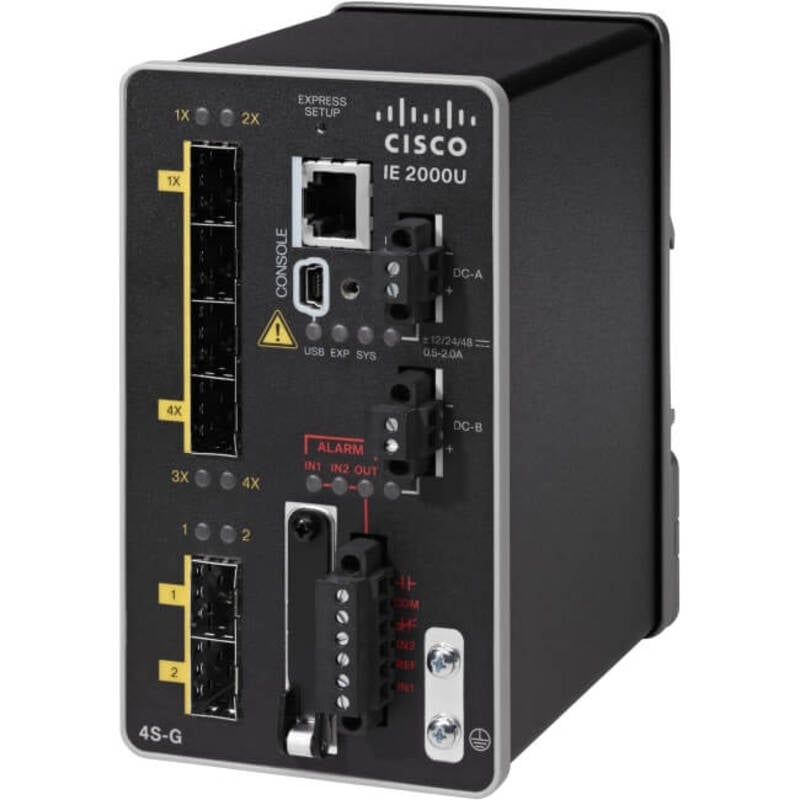
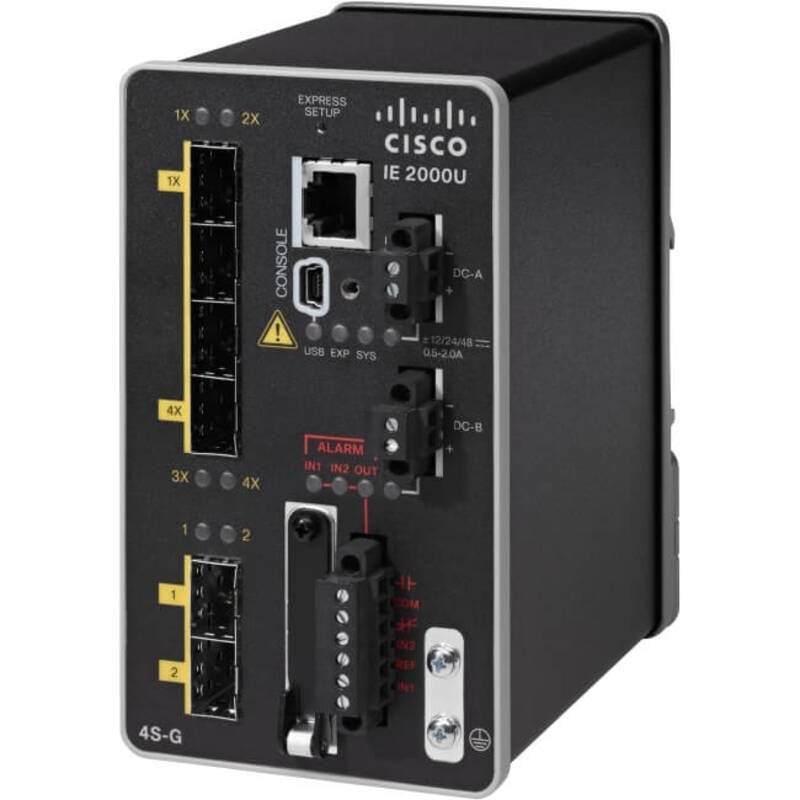
The Cisco IE-2000U-4S-G is a robust and manageable switch designed for industrial applications. It offers multiple ports and capabilities, including support for Small Form-Factor pluggable (SFP) modules, redundancy in power supply, and rail-mountable chassis. This guide explores the switch’s specifications, features, and how it serves various industrial needs.
Understanding the Cisco IE-2000U-4S-G
This switch is specifically crafted for use in harsh industrial environments, providing reliable networking solutions. It offers a combination of uplink and downlink ports and supports SFP modules, ensuring versatile connectivity options for different networking needs.
Key FeaturesPort
The IE-2000U-4S-G switch is equipped with 6 ports, offering flexibility in network connectivity for both uplink and downlink applications.
Small Form-Factor Pluggable (SFP) Support
SFP compatibility allows for the use of various SFP modules, enabling users to adapt the switch to different networking requirements, such as fiber optic or copper connections.
Redundant Power Supply Support
The switch’s capability to support redundant power supplies ensures continuous operation even in the event of a power supply failure, enhancing reliability in critical industrial environments.
Manageable Layer 2 Functionality
This switch operates at Layer 2 of the OSI model, providing efficient and manageable network functionalities, including VLAN support, traffic prioritization, and Quality of Service (QoS) capabilities.
Rail-Mountable Chassis
Its rail-mountable design allows for easy installation in industrial settings, enabling secure mounting on standard rails commonly found in industrial environments.
Advantages of Cisco IE-2000U-4S-GRobust Industrial Design
The switch’s design is tailored to withstand harsh industrial conditions, ensuring durability and reliability in challenging environments.
Flexible Connectivity
With support for SFP modules, the switch offers versatile connectivity options, allowing adaptation to various networking needs.
Redundancy for Reliability
The redundant power supply support enhances the reliability of the switch, minimizing downtime in critical industrial operations.
ApplicationsManufacturing Environments
The rugged design and reliable performance of the IE-2000U-4S-G make it suitable for use in manufacturing plants, providing robust networking solutions.
Transportation and Utilities
In the transportation and utility sectors, where reliability is crucial, this switch offers dependable networking capabilities for critical infrastructure.
Energy and Petrochemical Industry
The switch’s industrial-grade features make it ideal for deployment in energy and petrochemical facilities, ensuring continuous and secure networking operations.
Routing and Switching Protocols
The routing and switching protocols used by the IE-2000U-4S-G Cisco Industrial Ethernet 2000U Series 6 Ports Switch Chassis help to manage network traffic and ensure high network availability. Here is a brief description of each protocol:
- Spanning Tree Protocol (STP) – a network protocol that ensures a loop-free topology in a network by blocking certain redundant paths.
- Rapid Spanning Tree Protocol (RSTP) – an evolution of STP that provides faster convergence time in case of a network failure.
- Multiple Spanning Tree Protocol (MSTP) – a protocol that allows for multiple instances of STP to run in a single network, thereby allowing for multiple logical topologies.
- Virtual Router Redundancy Protocol (VRRP) – a protocol that provides redundancy for IP routers by allowing two or more routers to share a virtual IP address.
- Link Aggregation Control Protocol (LACP) – a protocol that allows multiple physical links to be grouped to form a single logical link.
- Hot Standby Router Protocol (HSRP) – a protocol that provides redundancy for IP routers by allowing two or more routers to share a virtual IP address.
- Internet Group Management Protocol (IGMP) – a protocol used by routers to learn which hosts belong to which multicast groups.
- Quality of Service (QoS) – a set of technologies and techniques used to manage network traffic and ensure that high-priority traffic receives the necessary bandwidth and that low-priority traffic does not consume too much bandwidth.
These protocols help to optimize network performance and ensure high network availability in the IE-2000U-4S-G Cisco Industrial Ethernet 2000U Series 6 Ports Switch Chassis.
Efficient Network
The IE-2000U-4S-G Cisco Industrial Ethernet 2000U Series 6 Ports Switch Chassis can be managed efficiently through the following methods:
- Web-based graphical user interface (GUI) – allows for a simple and intuitive method of managing the switch.
- Command Line Interface (CLI) – provides a powerful and flexible way to configure and manage the switch.
- SNMP (Simple Network Management Protocol) – allows for the switch to be monitored and managed from a central network management station.
- Auto Smartports – provides an automated method of configuring switch ports based on the type of device connected to it.
- Port Mirroring – allows for network traffic to be monitored and analyzed by duplicating incoming and outgoing traffic from one port to another.
- Link Aggregation – allows for multiple physical links to be grouped together to form a single logical link, providing increased bandwidth and redundancy.
- Quality of Service (QoS) – allows for network traffic to be classified, prioritized, and managed to ensure that high-priority traffic receives the necessary bandwidth and that low-priority traffic does not consume too much bandwidth.
Power Options and Redundancy
The IE-2000U-4S-G Cisco Industrial Ethernet 2000U Series 6 Ports Switch Chassis provides the following power options and redundancy features:
- Dual power input – supports redundant power inputs to ensure that the switch continues to operate even if one power source fails.
- Power over Ethernet (PoE) – allows for powered devices such as IP phones, wireless access points, and IP cameras to be powered from the switch, eliminating the need for external power sources.
- PoE redundancy – provides backup power for PoE-powered devices in the event of a power failure, ensuring that the devices continue to operate.
- Power supply redundancy – supports redundant power supplies to ensure that the switch continues to operate even if one power supply fails.
- DC power input – supports DC power inputs for environments where AC power is not available.
General Information about this Cisco IE-2000U-4S-G
- Manufacturer: Cisco
- Part Number or SKU# IE-2000U-4S-G
- Product Series: IE 2000U
- Product Type: Switch Chassis
Interfaces/Ports
- Uplink Port: No
- Modular: No
- Stack Port: No
- Port/Expansion Slot Details: 2 x Gigabit Ethernet Expansion Slot
- Port/Expansion Slot Details: 4 x Fast Ethernet Expansion Slot
Media & Performance
- Media Type Supported: Optical Fiber
- Media Type Supported: Twisted Pair
- Ethernet Technology: Fast Ethernet
- Ethernet Technology: Gigabit Ethernet
- Network Technology: 1000Base-X
- Network Technology: 10/100Base-T
I/O Expansions
- Number of Total Expansion Slots: 6
- Expansion Slot Type: SFP
- Shared SFP Slot: Yes
- Number of SFP Slots: 6
Network & Communication
- Layer Supported: 2
Management & Protocols
- Manageable: Yes
Power Description
- Power Source: Power Supply
- Redundant Power Supply: Yes
In summary, the Cisco IE-2000U-4S-G switch stands as a robust and reliable networking solution tailored for demanding industrial environments. With its SFP support, redundant power supply, Layer 2 manageability, and rail-mountable design, it offers versatile connectivity options and enhanced reliability, catering to diverse networking needs in various industrial sectors.