


Description
Product Overview
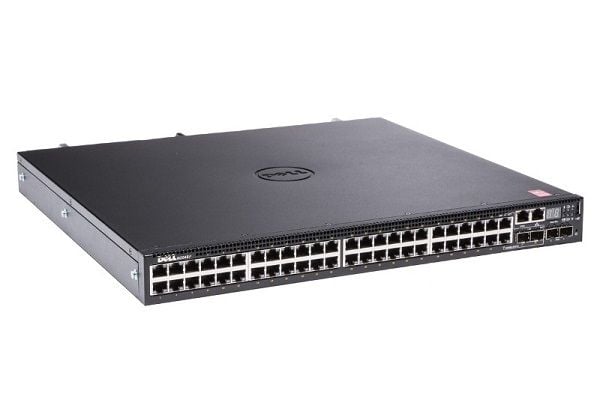
The CJXP5 Dell Networking N3048p Switch is a high-performance network switch with 48 ports. This switch is designed for use in enterprise-level networks, and it is capable of providing advanced features such as Layer 3 switching and management capabilities. In this article, we will explore the various features and benefits of the CJXP5 Dell Networking N3048p Switch in detail.
Ports and Connectivity
The CJXP5 Dell Networking N3048p Switch comes equipped with 48 ports, which makes it an ideal choice for large-scale networks. These ports support both Gigabit Ethernet and 10 Gigabit Ethernet, which provides ample bandwidth for data-intensive applications. The switch also includes two integrated 10 Gigabit Ethernet uplink ports, which can be used to connect the switch to other network devices or to a backbone network.
In addition to the physical ports, the CJXP5 Dell Networking N3048p Switch also includes support for virtual local area networks (VLANs). VLANs allow network administrators to segment their network into smaller, more manageable subnetworks. This can help to improve network performance and security by reducing the amount of broadcast traffic and by providing better access control.
Layer 3 Switching
The CJXP5 Dell Networking N3048p Switch is a Layer 3 switch, which means that it is capable of routing traffic between different subnets within a network. This functionality allows for more efficient use of network resources, as it reduces the amount of traffic that needs to be sent to a router for routing.
Layer 3 switching can also provide better network performance and security. For example, by implementing access control lists (ACLs) at the switch level, network administrators can better control the flow of traffic within their network. Additionally, Layer 3 switching can help to reduce the amount of broadcast traffic, which can improve network performance and reduce the risk of network attacks.
Management Capabilities
The CJXP5 Dell Networking N3048p Switch is a managed switch, which means that it can be configured and monitored using a variety of management tools. These tools allow network administrators to configure the switch to meet the specific needs of their network, as well as to monitor the switch for performance issues or other problems.
The switch supports several management protocols, including Simple Network Management Protocol (SNMP), Telnet, and Secure Shell (SSH). Additionally, the switch includes a web-based management interface, which provides an easy-to-use graphical user interface for managing the switch.
Other Features
In addition to the features mentioned above, the CJXP5 Dell Networking N3048p Switch includes several other features that make it a powerful and versatile networking solution. For example, the switch includes support for link aggregation, which allows network administrators to combine multiple physical connections into a single logical connection. This can provide increased bandwidth and redundancy, as well as improved network performance.
The switch also includes support for Quality of Service (QoS) features, which allow network administrators to prioritize certain types of traffic over others. This can be especially useful in networks that have a mix of data-intensive and latency-sensitive applications.
Overall, the CJXP5 Dell Networking N3048p Switch is a high-performance network switch that is designed for use in enterprise-level networks. With 48 ports, support for both Gigabit Ethernet and 10 Gigabit Ethernet, Layer 3 switching, and management capabilities, this switch provides a powerful and versatile networking solution. Additionally, features such as VLAN support, link aggregation, and QoS make this switch an ideal choice for organizations that require a high-performance, reliable, and flexible network infrastructure.
General Information about the Dell CJXP5
- Manufacturer: Dell
- MPN: CJXP5
- Type: Networking
- Switch Type: Network Switch 48 Port
Key Features
- Device Type : Switch – 48 Ports – L3 – Managed – Stackable
- Enclosure Type : Rack-mountable 1u
- Subtype : Gigabit Ethernet
- Ports : 48 X 10/100/1000 + 2 X 10 Gigabit Sfp+ + 2 X Combo 1000base-t
- Power Over Ethernet (poe) : Poe+
Performance
- Switching Fabric Bandwidth : 260 Gbps Forwarding Performance : 193 Mbps Stacking Bandwidth : 84 Gbps
- Capacity : Mac Addresses : 16384 Ipv4 Routes (static) : 1024 Ipv6 Routes (static) : 1024 Ipv4 Routes (dynamic) : 8160 Ipv6 Routes (dynamic) : 4096 Maximum Member Ports Per Lag : 8 Maximum Dynamic Ports Per Switch Stack : 144 Lag Groups : 128 Ospf Routes : 8160 Rip Routes : 512 Ecmp Next Hops Per Route : 4 Ecmp Groups : 64 Vlan Routing Interfaces : 128 Vlans Supported : 4094 Multicast Entries (ipv4) : 512 Multicast Entries (ipv6) : 256 Arp Entries : 6144 Ndp Entries : 400 Acl : 100 Maximum Rules Per Acl : 1023 Max Acl Rules System-wide : 4096 Maximum Acl Rules Per Interface (ipv4) Egress Rules : 1024 Maximum Acl Rules Per Interface (ipv4) Ingress Rules : 3072 Maximum Acl Rules Per Interface (ipv6) Egress Rules : 512 Maximum Acl Rules Per Interface (ipv6) Ingress Rules : 1021 Maximum Vlan Interfaces With Acls Applied : 24
- Mac Address Table Size : 16k Entries
- Routing Protocol : Ospf, Rip-1, Rip-2, Igmpv2, Igmp, Vrrp, Pim-sm, Pim-dm, Igmpv3, Ospfv3, Mldv2, Mld
- Remote Management Protocol : Snmp 2, Snmp, Rmon, Http, Ssh
Features
- Flow Control, Layer 3 Switching, Layer 2 Switching, Mdi/mdi-x Switch, Auto-negotiation, Load Balancing, Port Mirroring, Stackable, Weighted Round Robin (wrr) Queuing, Broadcast Storm Control, Rapid Spanning Tree Protocol (rstp) Support, Multiple Spanning Tree Protocol (mstp) Support, Access Control List (acl) Support, Quality Of Service (qos), Port Forwarding, Stp Root Guard, Lldp Support, Link Aggregation Control Protocol (lacp), Per-vlan Rapid Spanning Tree (pvrst), Energy Efficient Ethernet, Dynamic Vlan Support (gvrp), Dual Firmware Images, Network Access Control (nac), Tagged Vlan, Generic Vlan Registration Protocol (gvrp), Redundant Fans, Protocol-based Vlans Support
Compliant Standards :
Ieee 802.2, Ieee 802.3, Ieee 802.3u, Ieee 802.3z, Ieee 802.1d, Ieee 802.1q, Ieee 802.3ab, Ieee 802.1p, Ieee 802.3x, Ieee 802.3ad (lacp), Ieee 802.1w, Ieee 802.1x, Ieee 802.3ae, Ieee 802.3ac, Ieee 802.1s, Ieee 802.1v, Ieee 802.1ag, Ieee 802.1ab (lldp), Ieee 802.3az


