

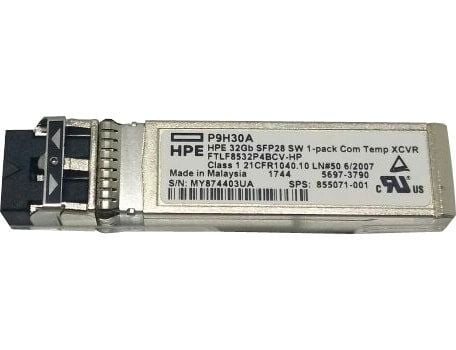
Description
Understanding Short Wave Propagation and Its Impact on Transceiver Performance
Short wave propagation refers to the transmission of electromagnetic signals at high frequencies over relatively short distances. In the context of fiber optic communications, short wave propagation typically refers to the use of short-wavelength light to transmit data over fiber optic cables.
The FTLF8532P4BCV-HP HPE 32G Fibre Channel (32GFC) Short-Wavelength SFP+ Optical Transceiver is a device that is designed to transmit data over fiber optic cables using short-wavelength light. This transceiver is designed to work with 32GFC fiber optic networks, which are high-speed networks used for storage area networking (SAN) applications.
The performance of the transceiver is affected by a number of factors related to short wave propagation. One of the most important factors is the quality of the fiber optic cable itself. The cable must be designed to minimize losses and other forms of signal degradation that can occur as the signal travels over the cable.
Other factors that can affect transceiver performance include the quality of the connectors used to attach the transceiver to the fiber optic cable, as well as the quality of the transceiver itself. High-quality transceivers are designed to minimize losses and other forms of signal degradation, which can improve the overall performance of the network.
In addition to these technical considerations, it is also important to consider the environmental conditions in which the network is being used. For example, the presence of electromagnetic interference (EMI) can affect short wave propagation and degrade the performance of the network.
Setting up and Installing of Optical Transceiver
The FTLF8532P4BCV-HP is a 32G Fibre Channel (32GFC) short-wavelength SFP+ optical transceiver module manufactured by Hewlett Packard Enterprise (HPE). This module is used for high-speed data transfer over optical fiber networks, and is designed to operate at a maximum data rate of 32Gbps.
Here are the steps to set up and install the FTLF8532P4BCV-HP HPE 32G Fibre Channel (32GFC) Short-Wavelength SFP+ Optical Transceiver:
- Ensure that your device or network equipment is compatible with the FTLF8532P4BCV-HP module. This module is designed to work with HPE networking equipment, but it may also be compatible with other manufacturers’ equipment that support 32GFC SFP+ transceivers.
- Power off the device or equipment that you will be installing the FTLF8532P4BCV-HP module into.
- Locate the SFP+ slot on the device or equipment. Most networking devices will have a slot on the front or rear panel labeled “SFP+.”
- Remove the protective dust cover from the SFP+ slot.
- Insert the FTLF8532P4BCV-HP module into the SFP+ slot. Be sure to align the module with the slot correctly, and apply gentle pressure until it clicks into place.
- Power on the device or equipment. The FTLF8532P4BCV-HP module should be detected automatically by the device, and the device should begin configuring the module.
- Verify that the FTLF8532P4BCV-HP module is functioning correctly by checking the device’s network interface status or diagnostic tools. You should see the module’s link status and data transfer rate.
- If the module is not functioning correctly, try reseating the module or contacting HPE support for further assistance.
Short Wave Transceivers for Amateur Radio Contesting
Shortwave transceivers are a type of radio equipment used by amateur radio operators during contests to communicate with other operators. These transceivers operate on high-frequency shortwave bands, which can transmit signals over long distances.
One example of a shortwave transceiver is the HPE 32G Fibre Channel (32GFC) Short-Wavelength SFP+ Optical Transceiver. This transceiver is a small, plug-and-play device that can be easily installed in a transceiver or other network device. It uses 32GFC technology to provide high-speed data transfer over short distances.
In a contest setting, shortwave transceivers like the HPE 32GFC transceiver can be used to quickly and efficiently exchange information with other operators. Contesting often involves trying to make as many contacts as possible in a limited amount of time, so having a reliable and fast transceiver is crucial.
Shortwave transceivers also often have features that are specifically designed for contesting, such as quick tuning and programmable memories for frequently-used frequencies. Additionally, they may have advanced filtering capabilities to reduce interference from other stations and improve signal clarity.
Main Specification about the HPE FTLF8532P4BCV-HP
- Manufacturer: HPE
- Part Number or SKU # FTLF8532P4BCV-HP
- Device Type: Transceiver
Technical Information
- Up To 28.05 GB/S Bi-Directional Data Links
- Hot-Pluggable SFP+ Footprint
- 850nm Oxide Vcsel Laser Transmitter
- Duplex Lc Connector
- Rohs Compliant
- 100m Over M5F MMF (50/125 UM OM4)
- 70M Over M5e MMF (50/125UM OM3)
- 20M ON 50 MM (OM2) MMF
- Metal Enclosure, For Lower EMI
- Single 3.3V Power Supply
- Operating Temperature Range: 0°C To 70°C


