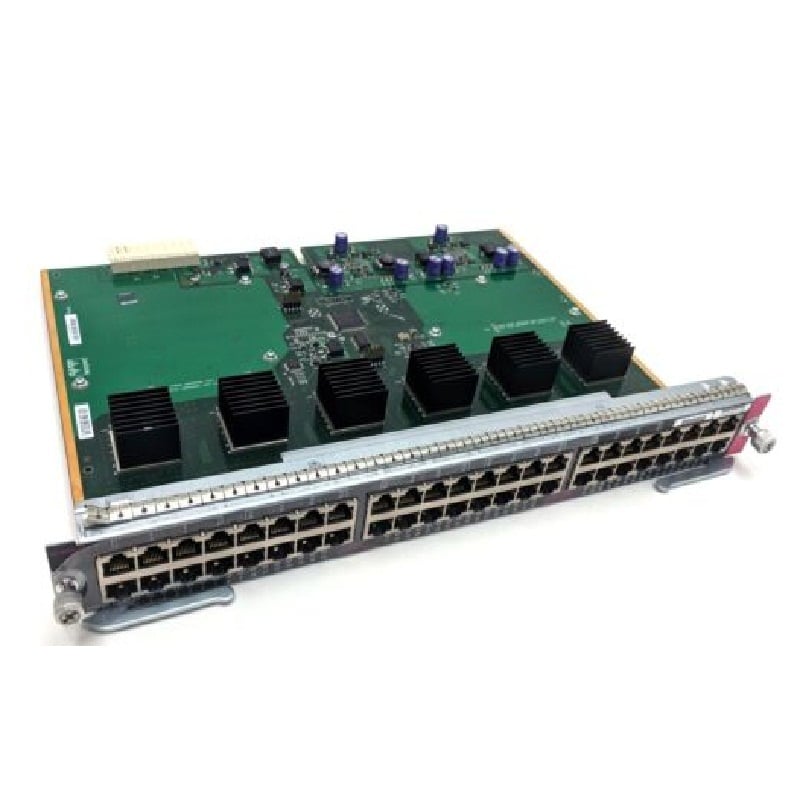
Description
Virtual LAN Support
The HP JE071A high-speed connectivity module supports Virtual LAN (VLAN) tagging, which is a technology used to create multiple virtual networks on a single physical network. VLANs allow for the segmentation of a network into smaller logical subnets, each with its own set of security and traffic management policies.
VLAN tagging is done by adding a VLAN identifier (tag). This tag is used to identify which VLAN the frame belongs to. Devices on the network can then use the tag to determine which VLAN the frame should be sent to. This allows for creating multiple virtual networks on a single physical network, which can improve security, traffic management and make the network more scalable.
The JE071A module supports IEEE 802.1Q VLAN tagging, which is a widely supported VLAN tagging standard. It allows for the creation of up to 4096 VLANs on the network, with each VLAN having its own unique tag. This feature allows the network administrator to segment the network into different VLANs based on the needs of the organization, such as separating different departments, applications or security zones.
In addition to VLAN tagging, the JE071A also supports Quality of Service (QoS) and link aggregation, which are other advanced features that can improve network performance and security. QoS allows for prioritizing different types of network traffic, and link aggregation allows for combining multiple network connections into a single logical connection to increase the available bandwidth.
Routing Protocols
The HP JE071A high-speed connectivity module is a Layer 2 switch and does not support routing protocols. Routing protocols are used to exchange routing information between routers in a network and determine the best path for data to travel from one network to another.
Since the JE071A module is a Layer 2 switch, it is responsible for forwarding data based on the Media Access Control (MAC) addresses of devices connected to the network. Layer 2 switches do not make routing decisions based on IP addresses and do not use routing protocols.
Instead, the JE071A module is used to provide high-speed connectivity to servers, storage devices, and other network devices in the data center and support advanced features such as Quality of Service (QoS), Virtual LAN (VLAN) tagging, and link aggregation. It can be used in conjunction with Layer 3 devices, such as routers or Layer 3 switches, which would handle routing decisions and use routing protocols to determine the best path for data to travel between networks.
Link Aggregation Control Protocol
The HP JE071A high-speed connectivity module supports Link Aggregation Control Protocol (LACP) also known as IEEE 802.3ad. LACP is a standard protocol used to bundle multiple physical network connections together to form a single logical connection. This process is also known as link aggregation or NIC teaming.
By using LACP, multiple physical links can be grouped together to form a single logical link. This increases the available bandwidth and provides redundancy. In case one of the physical links fails, the other links can take over the traffic, ensuring that the network stays up and running.
Link aggregation also allows the network administrator to balance the traffic across multiple links, which can improve network performance. LACP also allows the switch and the device at the other end of the link to exchange Link Aggregation Control Protocol Data Units (LACPDUs), which can detect the failure of one of the physical links and automatically adjust the traffic accordingly.
LACP is useful in situations where a single link may not be sufficient to handle the traffic demands of the network, such as in high-performance data center environments. The JE071A module supports LACP, which allows for the creation of link aggregation groups (LAGs) to bundle multiple physical links together to form a single logical link.
Detail Description
- Manufacturer: HP
- MPN: JE071A
- Type : Networking
- Switch-Type : Switch 48 Ports
- SKU: JE071A
- Enclosure Type : Rack-Mountable – 1u
- Advanced Switching : Layer 3
Networking
- Ports Qty : 48 X Ethernet 10base-T, Ethernet 100base-Tx, Ethernet 1000base-T
- Data Transfer Rate : 1 Gbps
- Data Link Protocol : Ethernet, Fast Ethernet, Gigabit Ethernet
- Routing Protocol : Static Ipv4 Routing, Static Ipv6 Routing
- Remote Management Protocol : Snmp 1, Rmon 1, Rmon 2, Rmon 3, Rmon 9, Telnet, Snmp 3, Snmp 2c, Http, Https, Cli
- Connectivity Technology : Wired
- Communication Mode : Full-Duplex
- Switching Protocol : Ethernet
- Mac Address Table Size : 16k Entries
Power
- Power Over Ethernet (Poe) : Yes
- Power Device : Power Supply
- Voltage Required : Ac 120/230 V ( 50/60 Hz )
Dimension and Weight
- Height: 1.7inch
- Width: 17.3inch
- Depth: 16.5inch
- Weight: 17 Lbs
Expansions and Connectivity
- Expansion Slots Total (Free) : 4 ( 4 ) X Sfp (Mini-Gbic) 2 ( 2 ) X Expansion Slot
- Interfaces : 48 X Network – Ethernet 10base-T/100base-Tx/1000base-T – Rj-45 1 X Management – Console – Rj-45