
Description
Port Configuration Management
Port Configuration Management refers to the process of configuring and maintaining the various network settings of individual ports on a switch. This includes setting up port speed, duplex mode, VLAN membership, port security, Quality of Service (QoS), and other parameters. The goal of port configuration management is to optimize network performance and security by controlling the flow of traffic through the switch and ensuring that each port is configured according to the specific requirements of the network.
In the case of the HPE 1950-24G-2SFP+ Switch, the port configuration can be managed through a web-based interface, the command-line interface (CLI), or through a network management software like HPE Network Manager. The switch provides a range of options for configuring the ports to meet the specific needs of different types of network devices and applications.
For example, port speed and duplex mode can be configured to match the requirements of the connected devices. The switch supports 10/100/1000 Mbps auto-negotiation and full-duplex or half-duplex modes. VLANs can be configured to create separate virtual networks within the switch, providing improved network security and performance. Quality of Service (QoS) can be configured to prioritize critical network traffic and ensure that important applications receive the necessary bandwidth.
Switching Technologies
Switching technologies refer to the methods used by switches to move data between different devices on a network. These technologies play a crucial role in ensuring fast, reliable, and secure network performance.
There are several different switching technologies used in modern networks, including:
- Store-and-Forward Switching: This method involves storing incoming data in memory before forwarding it to its destination. This allows the switch to perform error checking on the data, which helps to prevent errors and improve network reliability.
- Cut-Through Switching: This method allows the switch to begin forwarding data as soon as the destination address has been determined. This can result in faster data transfer speeds, but may also increase the risk of errors if the data is corrupted.
- Hybrid Switching: This method combines elements of both store-and-forward and cut-through switching, providing a balance between speed and reliability.
The HPE 1950-24G-2SFP+ Switch supports hybrid switching, which allows for fast data transfer speeds while also ensuring network reliability through error checking. This provides customers with the best of both worlds, ensuring that their network is fast and efficient, while also maintaining a high level of data integrity.
In addition to these basic switching technologies, the HPE 1950-24G-2SFP+ Switch also supports advanced features such as Quality of Service (QoS), Link Aggregation (LAG), and Spanning Tree Protocol (STP). These features help to optimize network performance and ensure high availability, making the switch an excellent choice for demanding network environments.
Compatibility and Interoperability
Compatibility and interoperability are important factors to consider when building and maintaining a network, especially when it comes to choosing networking equipment from different vendors.
The HPE 1950-24G-2SFP+ Switch is designed to be compatible and interoperable with other HPE networking products, allowing for easy integration into existing HPE network environments. This helps to simplify network deployment, management, and maintenance by ensuring that all components of the network work together seamlessly.
For example, the switch is compatible with HPE Network Manager, a network management software that provides a unified management interface for HPE network devices. This allows network administrators to manage the switch and other HPE networking products from a single interface, reducing the time and effort required to manage the network.
Additionally, the switch is interoperable with other HPE switches and routers, allowing for easy expansion and scaling of the network as needed. This helps to ensure that the network remains flexible and can adapt to changing business needs.
Main Specification about the HPE JG962-61001
- Manufacturer: HPE
- Part Number or SKU # JG962-61001
- Device Type: Managed Switch
Technical Information
- Enclosure type : rack-mountable – 1u
- Subtype : gigabit ethernet
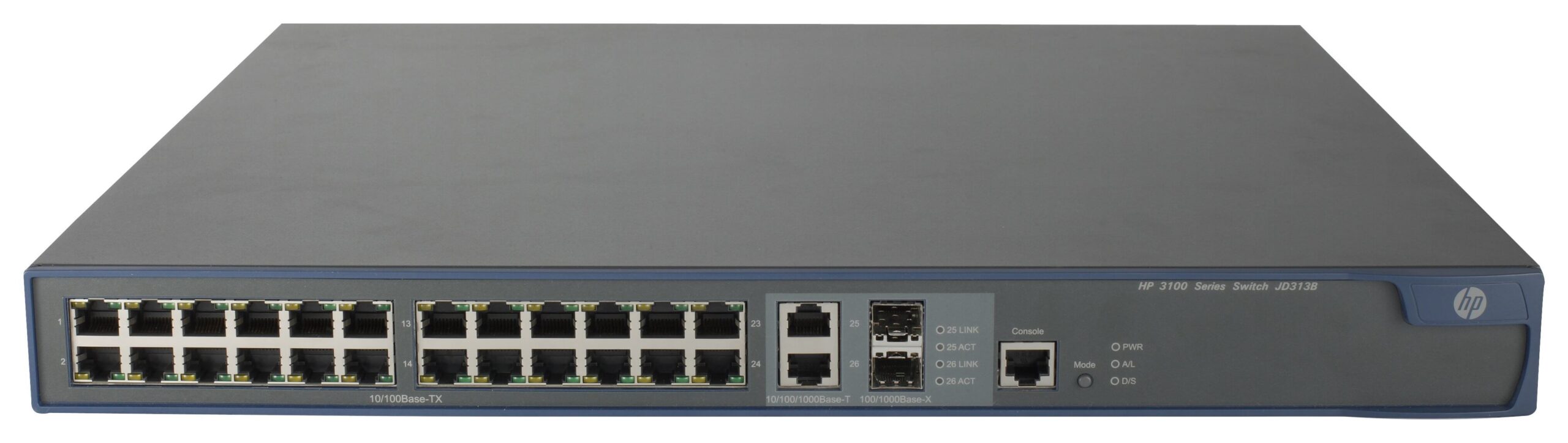
- Ports : 24 x 10/100/1000 (poe+) + 2 x gigabit sfp / 10 gigabit sfp+ + 2 x 10gb ethernet
- Power over ethernet (poe) : poe+
- Poe budget : 370 w
Performance
- Throughput (64-byte packet size) : up to 95.2 mpps ¦ routing/switching capacity : 128 gbps
- Capacity : static routes : 32 ¦ virtual interfaces (vlans) : 8 ¦ ipv4 routing table entries : 32 ¦ ipv6 routing table entries : 32
- Mac address table size : 16384 entries
- Jumbo frame support : 10kb
- Routing protocol : igmp, vrrp, static ipv4 routing, static ipv6 routing, ecmp
- Remote management protocol : snmp 1, rmon 2, rmon, snmp 3, snmp 2c, http, https, cli
Features
- Auto-uplink (auto mdi/mdi-x), igmp snooping, port mirroring, spanning tree protocol (stp) support, access control list (acl) support, quality of service (qos), stp root guard, link aggregation control protocol (lacp), dhcp client, packet storm protection, class of service (cos)
- Ram : 1 gb (max) – sdram
- Flash memory : 128 mb
Expansion / Connectivity
- Interfaces : 24 X 1000base-T – Rj-45 – Poe+ ¦ 2 X Gigabit / 10gbit Lan – Sfp+ ¦ 2 X 10gbase-T – Rj-45 ¦ 1 X Console – Rj-45 – Management
Power
- Power device : internal power supply
- Voltage required : ac 120/230 v ( 50/60 hz )