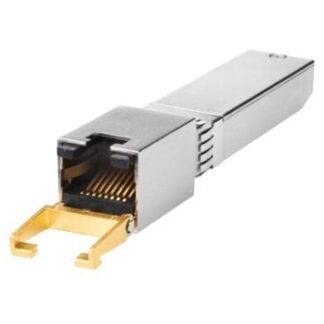

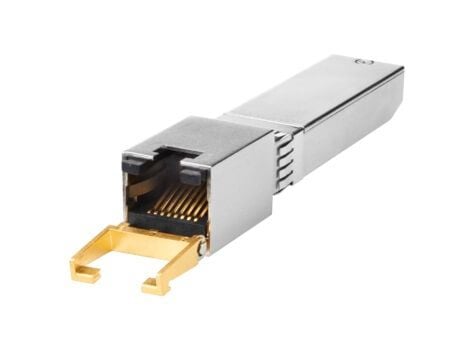
Description
Redundancy and High Availability
Redundancy and high availability are important considerations in data center and enterprise networking environments, as they help to ensure that critical network infrastructure components, such as the 813876-001 HPE 10GBase-T SFP+ Transceiver, remain operational and accessible even in the event of a hardware failure or outage.
The 813876-001 HPE 10GBase-T SFP+ Transceiver supports several redundancy and high availability features, including link aggregation and failover. Link aggregation, also known as link bonding or port trunking, allows multiple physical network connections to be combined into a single logical connection, providing increased bandwidth and redundancy. In the event that one connection fails, traffic is automatically rerouted through the remaining connections, ensuring that network traffic continues to flow and preventing downtime.
Failover is another important feature that provides high availability and redundancy. In the event that a network connection or device fails, failover technology automatically switches to a backup connection or device, ensuring that critical network functions and applications remain accessible and operational.
Additionally, the 813876-001 HPE 10GBase-T SFP+ Transceiver supports hot-swappable capabilities, allowing the transceiver to be replaced or removed without interrupting network traffic or requiring a system shutdown. This enables administrators to perform maintenance or upgrades without causing downtime or disruption to network operations.
The redundancy and high availability features of the 813876-001 HPE 10GBase-T SFP+ Transceiver help to ensure that critical network infrastructure components remain operational and accessible, even in the event of a hardware failure or outage, providing increased reliability and uptime for data center and enterprise networking environments.
Network Virtualization Support
Network virtualization is a technique that allows multiple virtual networks to be created and managed on top of a physical network infrastructure, providing increased flexibility and scalability for data center and enterprise networking environments. The 813876-001 HPE 10GBase-T SFP+ Transceiver supports network virtualization, allowing for the creation and management of virtual networks.
The 813876-001 HPE 10GBase-T SFP+ Transceiver supports several network virtualization technologies, including Virtual Extensible LAN (VXLAN) and Network Virtualization using Generic Routing Encapsulation (NVGRE). These technologies enable the creation of virtual networks that are independent of the physical network infrastructure, allowing for increased flexibility and scalability.
VXLAN is a network virtualization technology that allows for the creation of virtual networks across different physical networks, enabling the creation of large-scale, multi-tenant environments. NVGRE is another network virtualization technology that provides similar capabilities, allowing for the creation of virtual networks that are independent of the physical network infrastructure.
The 813876-001 HPE 10GBase-T SFP+ Transceiver also supports the creation and management of virtual networks using network virtualization overlays, such as VMware NSX and Microsoft Hyper-V Network Virtualization. These overlays provide a software-based approach to network virtualization, allowing for the creation and management of virtual networks that are isolated from the physical network infrastructure.
The network virtualization support of the 813876-001 HPE 10GBase-T SFP+ Transceiver enables the creation and management of virtual networks, providing increased flexibility and scalability for data center and enterprise networking environments.
Quality of Service (QoS) Support
Quality of Service (QoS) is a technique used in computer networks to prioritize different types of network traffic according to their importance or the service level required. The 813876-001 HPE 10GBase-T SFP+ Transceiver supports QoS, which helps to ensure that critical network traffic is given priority over less important traffic, ensuring that the network performs optimally.
The 813876-001 HPE 10GBase-T SFP+ Transceiver supports several QoS mechanisms, including traffic classification, traffic shaping, and priority queuing. Traffic classification allows network administrators to identify and categorize different types of network traffic based on their importance or service level required. Traffic shaping allows administrators to limit the amount of network traffic that can be sent at a given time, ensuring that the network does not become congested. Priority queuing is a mechanism that allows higher-priority traffic to be transmitted before lower-priority traffic, ensuring that critical traffic is given priority.
The 813876-001 HPE 10GBase-T SFP+ Transceiver also supports Differentiated Services Code Point (DSCP), which is a QoS mechanism that allows network administrators to assign different levels of priority to network traffic based on its type or importance. DSCP is a flexible and scalable QoS mechanism that can be used to ensure that critical network traffic is given priority over less important traffic.
The QoS support of the 813876-001 HPE 10GBase-T SFP+ Transceiver helps to ensure that critical network traffic is given priority over less important traffic, ensuring that the network performs optimally and providing increased reliability and performance for data center and enterprise networking environments.
General Information
- Device Type : Sfp+ Transceiver Module
- Form Factor : Plug-In Module
Networking
- Connectivity Technology : Wired
- Cabling Type : 10gbase-T
- Data Link Protocol : 10 Gigabit Ethernet
- Data Transfer Rate : 10 Gbps
- Max Transfer Distance : 98 Ft