

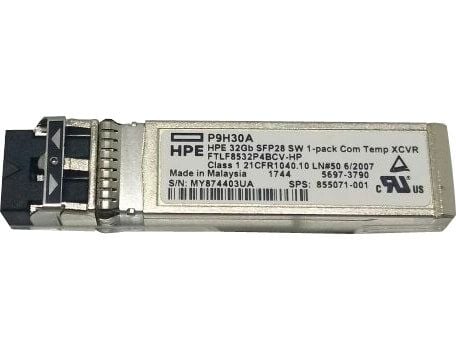
Description
Innovations in Optical Transceiver Technology
Optical transceiver technology has undergone several innovations in recent years, including with the HPE 855071-001 32G Fibre Channel (32GFC) Short-Wavelength SFP+ Optical Transceiver. Some of these innovations include:
- Higher Bandwidth: Optical transceivers are now capable of higher bandwidths, allowing for faster and more efficient data transmission.
- Lower Power Consumption: Advances in technology have allowed for optical transceivers to use less power, which can help to reduce energy costs and improve the overall energy efficiency of a network.
- Smaller Form Factors: Optical transceivers are becoming smaller and more compact, making them easier to install and use in a range of different network environments.
- Multi-Protocol Support: Optical transceivers can now support multiple protocols, allowing them to be used with a wider range of devices and applications.
- Digital Diagnostic Monitoring (DDM): DDM allows for real-time monitoring of the performance of optical transceivers, including information on temperature, signal strength, and other metrics.
- Smart Tuning Technology: Some optical transceivers now feature smart tuning technology, which can adjust and optimize the performance of the transceiver based on the specific network and application it is being used with.
- Longevity: Optical transceivers now have longer lifespans and can withstand more environmental stressors than older models.
These innovations in optical transceiver technology have helped to make networks faster, more efficient, and more reliable. The HPE 855071-001 transceiver is designed to incorporate many of these innovations and provide high-speed, low-power, and versatile optical connectivity for a range of different networks and applications.
Maintenance and Troubleshooting
Proper maintenance and troubleshooting are important for ensuring the reliable and efficient operation of the HPE 855071-001 32G Fibre Channel (32GFC) Short-Wavelength SFP+ Optical Transceiver. Here are some tips for maintaining and troubleshooting the transceiver:
Maintenance:
- Regular cleaning: Dust and debris can accumulate on the transceiver and fiber optic cables, which can degrade the signal quality and affect performance. Regularly clean the transceiver and cables using a lint-free cloth and isopropyl alcohol.
- Keep the transceiver cool: The transceiver generates heat, and if it becomes too hot, it can affect the performance and lifespan of the transceiver. Ensure that the transceiver is well-ventilated and has proper airflow.
- Check for firmware updates: Manufacturers often release firmware updates for optical transceivers to improve performance and address any known issues. Check for firmware updates regularly and install them as needed.
Troubleshooting:
- Check the connection: If the network connection is slow or not working, check the fiber optic cable connection and ensure that it is properly seated and connected.
- Check the transceiver settings: Ensure that the transceiver is configured correctly, including speed, bandwidth, and other parameters. Incorrect settings can cause issues with performance.
- Monitor the network: Use diagnostic tools to monitor the network and track performance, including signal strength, error rates, and other metrics.
- Replace the transceiver: If the transceiver is not working correctly, it may need to be replaced. Contact the manufacturer or a qualified technician to assist with replacing the transceiver.
Performance of Fibre Channel
The HPE 855071-001 32G Fibre Channel (32GFC) Short-Wavelength SFP+ Optical Transceiver is designed to provide high-speed and reliable optical connectivity for Fibre Channel networks. Fibre Channel is a high-speed data transfer protocol that is commonly used in data centers and other enterprise-level network environments.
The 32GFC protocol, which is supported by the HPE 855071-001 transceiver, provides data transfer rates of up to 32 Gbps, making it one of the fastest Fibre Channel protocols available. This high-speed data transfer rate enables large amounts of data to be transferred quickly and efficiently, reducing latency and improving overall network performance.
In addition to high-speed data transfer, Fibre Channel also offers a number of other performance benefits, including:
- Low Latency: Fibre Channel provides low latency, which is essential for real-time applications that require quick data transfer and response times.
- High Reliability: Fibre Channel is highly reliable and is designed to maintain data integrity even in the face of network failures or other issues.
- Scalability: Fibre Channel networks can be easily scaled to support growing data transfer needs, making them ideal for large-scale data center environments.
- Distance: Fibre Channel can support data transfers over long distances, making it suitable for distributed network environments.
The HPE 855071-001 transceiver is designed to provide high-performance and reliable optical connectivity for Fibre Channel networks, enabling fast and efficient data transfer over long distances with low latency and high data integrity.
General Information
- Manufacturer: HPE
- Part Number or SKU# 855071-001
- Product Type : Transceiver
Technical Information
- Up To 28.05 Gb/S Bi-Directional Data Links
- Hot-Pluggable SFP+ Footprint
- 850nm Oxide Vcsel Laser Transmitter
- Duplex Lc Connector
- Rohs Compliant
- 100M Over M5f MMF (50/125 UM OM4)
- 70M Over M5e MMF (50/125UM OM3)
- 20M ON 50 Mm (Om2) Mmf
- Metal Enclosure, For Lower Emi
- Single 3.3V Power Supply
- Operating Temperature Range: 0°C To 70°C


