

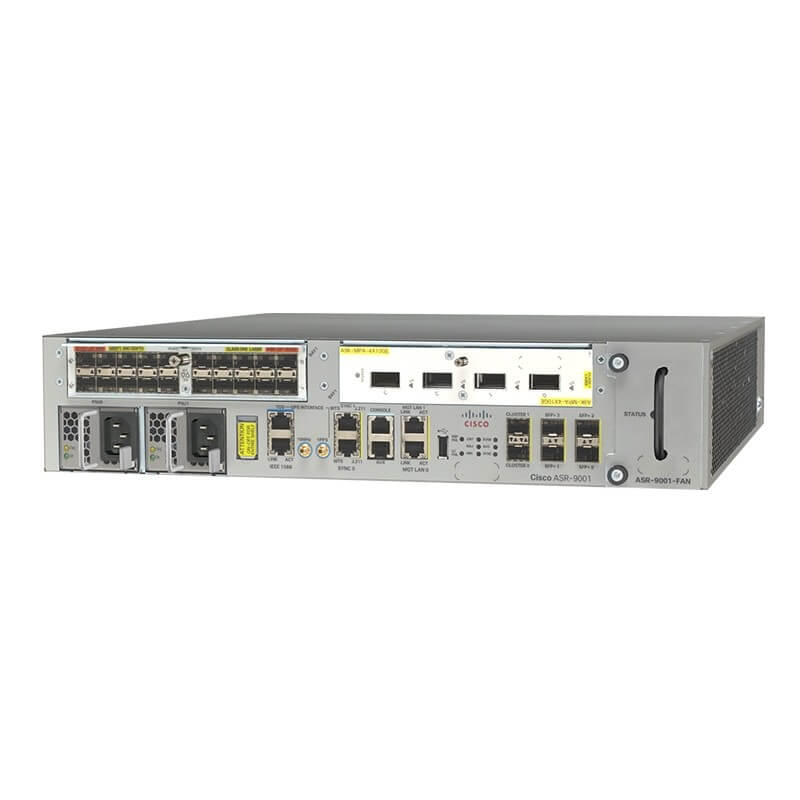
Description
Maximizing Performance and Scalability
Maximizing performance and scalability of the CHAS-UBR7225VXR UBR 7225VXR 3-slot router chassis involves making changes to the router’s software and hardware in order to improve its ability to handle high volumes of traffic and support a growing number of devices on the network.
- Upgrading the router’s software to the latest version will ensure that the router is running on the most current, stable and secure version, with new features and bug fixes that can improve performance and security.
- Monitoring and optimizing the router’s resource utilization will help ensure that the router is using its available memory and CPU efficiently, which is important for maintaining good performance.
- Using Quality of Service (QoS) features to prioritize traffic will help prevent network bottlenecks and ensure that critical data is delivered in a timely manner.
- Link aggregation can be used to increase bandwidth and provide redundancy, which is important for maintaining high availability and ensuring that the network remains up and running even if one link fails.
- Using virtual routing and forwarding (VRF) can increase the scalability of the network by creating multiple virtual routers within the same physical router, which can help support a growing number of devices on the network.
- The modular nature of the UBR 7225VXR allows for adding or upgrading components as needed, such as installing additional line cards or interfaces to increase port capacity, which is important for supporting a growing number of devices on the network.
- Using security features such as firewalls, VPNs, and intrusion detection and prevention systems can help protect the network from external threats and maintain the security of the network.
Remote Management Protocols
The CHAS-UBR7225VXR UBR 7225VXR 3-slot router chassis supports several remote management protocols, which allow network administrators to manage the router remotely. The most commonly used protocols for remote management are:
- Telnet: Telnet is a text-based protocol that allows administrators to remotely log in to the router’s command-line interface (CLI) and execute commands.
- SSH: SSH (Secure Shell) is a secure version of Telnet that encrypts the data being transmitted, making it more secure than Telnet.
- SNMP: SNMP (Simple Network Management Protocol) is a widely used protocol for managing and monitoring network devices. SNMP allows administrators to collect information about the router’s performance, status, and configuration.
- HTTP/HTTPS: HTTP and HTTPS (Hypertext Transfer Protocol and Secure Hypertext Transfer Protocol) are used to access the router’s web-based management interface, which provides a graphical user interface (GUI) for managing the router.
- RMON: RMON (Remote Monitoring) is a standard for monitoring and analyzing network traffic. RMON allows administrators to collect statistics about the router’s performance, such as traffic statistics and error rates.
- syslog: syslog is a standard for sending log messages from devices on the network. syslog allows administrators to collect log messages from the router, which can be used for troubleshooting and security purposes.
Features and Benefits
The CHAS-UBR7225VXR UBR 7225VXR 3-slot router chassis is a high-performance modular router designed to meet the needs of service providers and large enterprise networks. Some of the features and benefits of the UBR 7225VXR include:
- Modularity: The UBR 7225VXR is a modular router, which means that the different components of the router can be easily added or replaced as needed. This allows for easy upgrade of the router’s performance and capacity as the network grows.
- High-performance routing: The UBR 7225VXR supports a wide range of routing protocols, including BGP, OSPF, and EIGRP, and provides high-performance routing for large enterprise networks and service providers.
- Quality of Service (QoS): The UBR 7225VXR supports advanced QoS features, such as traffic shaping and prioritization, which allows for efficient use of network resources and ensures that critical data is delivered in a timely manner.
- Security: The UBR 7225VXR supports a wide range of security features, such as firewalls, VPNs, and intrusion detection and prevention systems, which help protect the network from external threats.
- Virtual routing and forwarding (VRF): The UBR 7225VXR supports VRF, which allows for the creation of multiple virtual routers within the same physical router. This allows for increased scalability of the network and supports a growing number of devices.
- High availability: The UBR 7225VXR supports high availability features such as Hot Standby Router Protocol (HSRP) and Virtual Router Redundancy Protocol (VRRP) which help to ensure that the network remains up and running even if one component fails.
- Remote management: The UBR 7225VXR supports several remote management protocols, such as Telnet, SSH, SNMP, HTTP/HTTPS, RMON and Syslog, which allows network administrators to manage the router remotely.
General Information
- Manufacturer Cisco
- Manufacturer Part Number CHAS-UBR7225VXR
- Product Series uBR7200
- Product Model uBR7225VXR
- Product Name uBR7225VXR Router Chassis
- Product Type Router Chassis
I/O Expansions
- Number of Total Expansion Slots 3
- Expansion Slot Type Line Card, Network Processing Engine
Network & Communication
- VoIP Supported No
Management & Protocols
- Security Features
- L2VPN
- DOCSIS Baseline Privacy Interface (BPI)
Power Description
- PoE (RJ-45) Port No
- Input Voltage 110 V AC, 220 V AC
- Redundant Power Supply Supported Yes


