

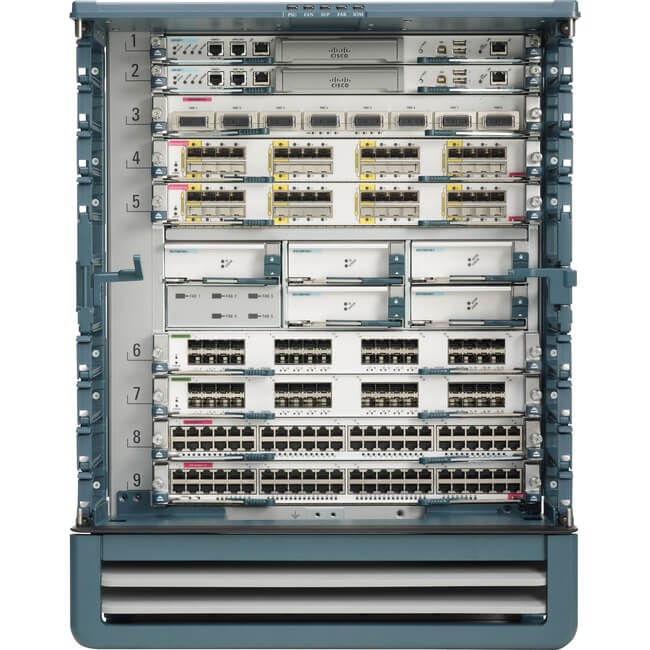
Description
Port Configuration and Capacity
The N7K-C7009-B2S2E Cisco Nexus 7009 Bundle Layer 3 Managed Switch is a high-performance switch designed for data center and campus core applications. It supports advanced features like virtualization, security, and automation, and provides scalable and resilient connectivity for a wide range of networking environments.
One important aspect of the N7K-C7009-B2S2E switch is its port configuration and capacity. This switch comes with 10 slots for line cards, each of which can support various types of Ethernet and Fibre Channel interfaces. In total, the switch can support up to 576 10 Gigabit Ethernet ports, or up to 192 40 Gigabit Ethernet ports, depending on the type of line card used. Additionally, the switch has two fabric modules that provide high-speed interconnectivity between the line cards, allowing for efficient data transfer and low latency.
The N7K-C7009-B2S2E switch also supports various advanced features like virtual PortChannel (vPC), which allows multiple physical links to be aggregated into a single logical interface, and FabricPath, which provides scalable and efficient layer 2 connectivity for large data center networks. The switch also supports advanced security features like ACLs and port security, as well as automation features like Cisco Nexus Data Broker, which provides a centralized platform for network visibility and analytics.
Security Features and Access Control
The N7K-C7009-B2S2E Cisco Nexus 7009 Bundle Layer 3 Managed Switch is a high-performance switch that is designed to provide advanced security features and access control to ensure the safety and integrity of data. Some of the security features and access control capabilities of this switch include:
- ACLs (Access Control Lists): The switch supports ACLs that allow the administrator to control access to the network based on various criteria, such as source/destination IP addresses, protocol type, and port numbers.
- VLANs (Virtual Local Area Networks): VLANs provide an additional layer of security by segregating traffic based on logical grouping rather than physical location.
- Port Security: The switch supports port security, which allows the administrator to limit the number of MAC addresses that can be learned on a specific port.
- Private VLANs: Private VLANs allow for additional security by isolating ports within a VLAN, ensuring that devices cannot communicate with each other.
- Authentication: The switch supports various authentication methods, such as 802.1x, MAC authentication, and Web authentication, which allows for granular control over access to the network.
- Encryption: The switch supports various encryption protocols, such as SSH, SSL, and SNMPv3, which ensure secure communication between devices on the network.
- Role-Based Access Control: Role-Based Access Control (RBAC) allows the administrator to define roles for users and grant access to network resources based on their assigned role.
- Multifactor Authentication: The switch supports multifactor authentication, which requires multiple forms of authentication, such as a password and a smart card, before granting access to the network.
Quality of Service (QoS) Configuration
Quality of Service (QoS) configuration refers to the process of setting up policies and rules that prioritize certain types of network traffic over others, in order to ensure optimal performance and responsiveness for critical applications and services. The N7K-C7009-B2S2E Cisco Nexus 7009 Bundle Layer 3 Managed Switch is a high-performance, scalable and modular switch that supports advanced QoS features to help manage and control network traffic.
To configure QoS on the Cisco Nexus 7009 switch, the administrator can use the Cisco NX-OS command-line interface (CLI) or the Cisco Nexus Dashboard (formerly known as Cisco DCNM). Some of the key QoS features supported by the switch include:
- Classification: This feature allows the administrator to identify and classify different types of network traffic based on their source, destination, port number, protocol, or other attributes. The switch supports a variety of classification methods, including access control lists (ACLs), class maps, policy maps, and match criteria.
- Marking: This feature enables the administrator to apply various QoS markings to classified traffic, such as Differentiated Services Code Point (DSCP), IP Precedence, or MPLS Experimental bits. These markings can then be used by downstream devices to prioritize and shape the traffic.
- Policing: This feature provides a mechanism for controlling the rate of incoming and outgoing traffic on a per-port or per-class basis. The administrator can set upper and lower limits on the amount of traffic that can be sent or received, and specify how to handle excess traffic, such as dropping or marking it.
- Queueing: This feature enables the administrator to allocate and manage different types of network traffic into separate queues, based on their QoS markings or other criteria. Each queue can be assigned a specific amount of buffer memory and scheduling algorithm, to ensure fair and efficient distribution of bandwidth among competing flows.
- Shaping: This feature allows the administrator to smooth out traffic bursts and regulate the flow of traffic to conform to a specific rate limit or traffic profile. Traffic shaping can be applied on a per-port or per-class basis, using various shaping algorithms, such as token bucket or rate limit.
General Information
- Manufacturer Cisco Systems, Inc
- Manufacturer Part Number N7K-C7009-B2S2E
- Brand Name Cisco
- Device Type Switch – L3 – managed – with Cisco Nexus 7000 Series Supervisor 2 Module, 5x Cisco Nexus 7000 Series Fabric-2 Module
- Enclosure Type Rack-mountable 14U
- Remote Management Protocol SNMP, CLI
- Features Modular design
- Processor 2 x Intel Xeon: 2.13 GHz
- RAM 32 GB
- Flash Memory 8 GB
Expansion / Connectivity
- Interfaces 1 x console – RJ-45 management ¦ 1 x console RJ-45 ¦ 3 x USB
- Expansion Slots 14 (total) / 8 (free) x expansion slot
- Installed Modules Qty (Max) 6 (installed) / 14 (max)
Environmental Parameters
- Max Operating Temperature 104 °F
- Humidity Range Operating 5 – 90% (non-condensing)
- Min Storage Temperature -40 °F
- Max Storage Temperature 158 °F
- Humidity Range Storage 5 – 95% (non-condensing)
Power
- Power Device Internal power supply – hot-plug
- Installed Qty 0 (installed) / 2 (max)


