


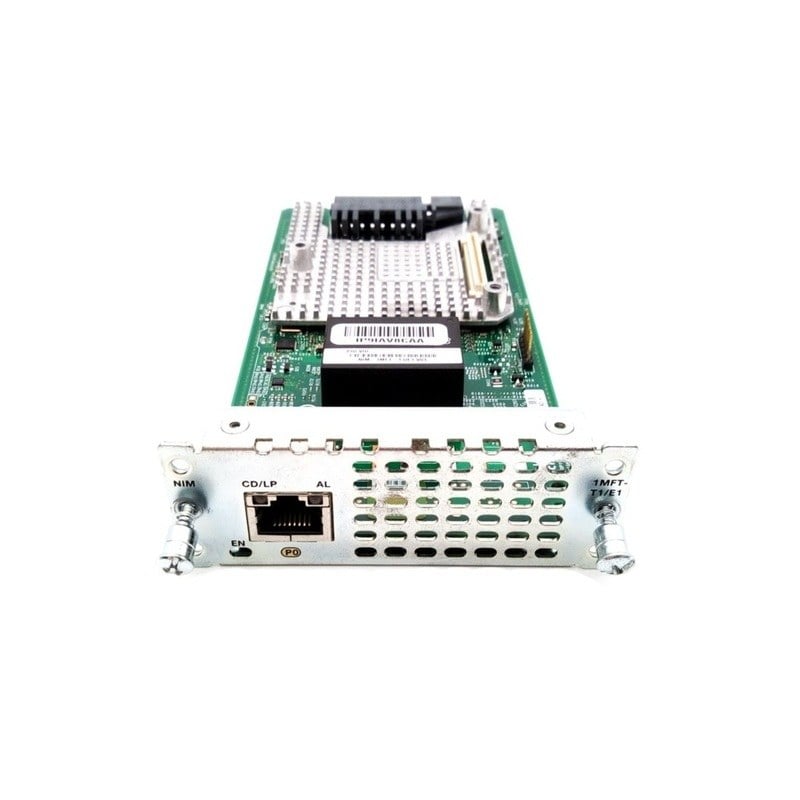

Description
Overview of the NIM-1MFT-T1/E1 Cisco 4G Voice WAN Interface Module
The NIM-1MFT-T1/E1 Fourth-Generation module is a cutting-edge networking solution designed to provide advanced voice and data capabilities in Wide Area Networks (WANs). In this comprehensive guide, we will delve into the features, specifications, and applications of the NIM-1MFT-T1/E1 module, focusing on its T-Carrier Level 1 (T1) and E-Carrier Level 1 (E1) capabilities.
Understanding the NIM-1MFT-T1/E1 Voice WAN Interface Card
The NIM-1MFT-T1/E1 module is a versatile networking component that supports both T1 and E1 technologies. T1 and E1 are standardized digital transmission formats widely used in telecommunications for voice and data communication. Let’s explore the key features of this fourth-generation module:
- Port Configuration: The NIM-1MFT-T1/E1 module is equipped with one port, making it a single-channel Multi-Flex Trunk (MFT) solution. This port supports both voice and clear-channel data transmission, providing flexibility for various communication needs.
- Data Rates: The module offers high-speed data transmission, with a rate of 197.63 kilobits per second (KB/s) for T1 and 262.14 KB/s for E1. This capability ensures efficient data transfer, making it suitable for applications with demanding bandwidth requirements.
- Voice Wide Area Network: NIM-1MFT-T1/E1 is specifically designed for Voice WAN deployments. It enables seamless integration of voice communication over WANs, facilitating clear and reliable voice calls across extended geographical distances.
- T-Carrier Level 1 (T1) Technology: T1 is a widely used digital transmission format in North America. The module’s T1 compatibility makes it suitable for networks requiring 24 multiplexed voice channels or clear-channel data at a rate of 1.544 megabits per second (Mbps).
- E-Carrier Level 1 (E1) Technology: E1 is a standard digital transmission format in Europe and other parts of the world. The NIM-1MFT-T1/E1 module’s E1 compatibility allows it to support 30 voice channels or clear-channel data at a rate of 2.048 Mbps, meeting the requirements of diverse international networks.
Applications of NIM-1MFT-T1/E1 1-port Module
Now that we have explored the features of the NIM-1MFT-T1/E1 module, let’s delve into its practical applications across various industries:
- Telecommunications: The module finds extensive use in telecommunications networks, serving as a crucial component for voice and data transmission. Its compatibility with both T1 and E1 technologies makes it adaptable to diverse global telecommunication standards.
- Enterprise Networks: In enterprise settings, the NIM-1MFT-T1/E1 module is employed to establish reliable and high-performance WAN connections. Its ability to handle voice traffic efficiently makes it ideal for organizations with decentralized structures.
- VoIP Integration: The module seamlessly integrates with Voice over Internet Protocol (VoIP) systems, enabling organizations to leverage modern communication technologies. This integration enhances the efficiency of voice communication over IP networks.
- International Connectivity: With support for both T1 and E1 standards, the module facilitates international connectivity, allowing businesses with global operations to establish communication links that adhere to regional standards.
- Data-Intensive Applications: The high data rates offered by the NIM-1MFT-T1/E1 module make it suitable for data-intensive applications, including video conferencing, large file transfers, and real-time collaboration tools.
Reliability of Cisco Wide Area Network
The Cisco 4G Voice and WAN Network Interface Module (NIM-1MFT-T1/E1) is a reliable interface card that is designed for use in Cisco routers. It is built to high-quality standards and is designed to withstand the rigors of use in demanding network environments.
The NIM-1MFT-T1/E1 is equipped with a number of features that contribute to its reliability. For example, it is designed to operate over a wide temperature range, allowing it to be used in a variety of different environments. It is also equipped with a range of connectivity options, including Ethernet, Wi-Fi, and Bluetooth, which provide multiple ways to connect to other devices and systems.
Technical Specifications
- The NIM-1MFT-T1/E1 module operates at a data transfer rate of 197.63 kilobits per second (KB/s) for T1 and 262.14 KB/s for E1. This high-speed capability makes it suitable for demanding applications where efficient data transfer is crucial.
T1 and E1 Standards
- T1 Standard: The T1 standard specifies a digital transmission rate of 1.544 megabits per second (Mbps). This is commonly used in North America for voice and data communication.
- E1 Standard: The E1 standard, with a transmission rate of 2.048 Mbps, is prevalent in Europe and other parts of the world. It is also a widely adopted standard for voice and data transmission.
E1.2.048 Compliance
- The module complies with the E1.2.048 standard, ensuring adherence to international protocols for E1-based communication. This compliance is vital for interoperability and seamless integration into global networks.
Deployment ConsiderationsNetwork Architecture Integration
- Before deploying the NIM-1MFT-T1/E1 module, it is crucial to assess and plan for seamless integration into the existing network architecture. Compatibility checks with routers, switches, and other network components should be conducted to ensure a smooth deployment process.
Bandwidth Management
- Given the module’s capability to handle both voice and data, effective bandwidth management is essential. Network administrators should prioritize and allocate bandwidth according to the specific requirements of voice and data applications to optimize performance.
Security Measures
- As with any network module, implementing robust security measures is imperative. Encryption protocols, access controls, and regular security audits should be part of the deployment strategy to safeguard sensitive voice and data transmissions.
Compatibility and Interoperability
The Cisco 4G Voice and WAN Network Interface Module (NIM-1MFT-T1/E1) is designed to be compatible with a range of network devices and protocols, ensuring its interoperability with other network components.
Compatibility: The NIM-1MFT-T1/E1 module is compatible with the Cisco Integrated Services Router (ISR) family of products, allowing it to be easily integrated into your existing network infrastructure. The module supports the T1 and E1 protocols, which are widely used for voice and data communication over WAN interfaces, and it is compatible with a range of voice and data services, such as voice over IP (VoIP), multimedia conferencing, and data transfer.
Interoperability: The NIM-1MFT-T1/E1 module is designed to be interoperable with a range of network devices and protocols, ensuring its compatibility with your existing network infrastructure. The module supports the common communication protocols used in voice and data networks, including IP, Frame Relay, ATM, and Point-to-Point Protocol (PPP), ensuring that it can seamlessly integrate with your existing network components.
In addition, the NIM-1MFT-T1/E1 module supports the integration with a range of network management tools and applications, such as network performance monitoring software and security management systems, ensuring that it can be easily managed and monitored as part of your overall network.
General Information of the Cisco NIM-1MFT-T1/E1 WAN Interface Card
- Manufacturer: Cisco
- Model Number or SKU# NIM-1MFT-T1/E1
- Product Type: WAN Interface Card
Performance of Interface Modules
- Connectivity Media: T1/E1
- Application/Usage: Voice Wide Area Network
- Data Transfer Rate:
- 1.54 Mbps (T1)
- 2.05 Mbps (E1)
Interfaces / Ports of WAN Interface Card
- Interfaces/Ports: 1 x T1/E1
- Interfaces/Ports Details: 1 x T1/E1 Network
Outline, the NIM-1MFT-T1/E1 Fourth-Generation module stands as a robust solution for voice and data communication in Wide Area Networks. Its compatibility with T1 and E1 technologies, along with high data rates, makes it a versatile choice for telecommunications providers, enterprises, and organizations with diverse networking needs. By understanding its features, applications, and proper installation procedures, network administrators can harness the full potential of this advanced networking module, contributing to the seamless and efficient operation of their communication networks.


