



Description
Understanding SATA-6GBPS Technology
SATA-6Gbps (SATA III) is a high-speed interface technology used for connecting storage devices such as hard drives, solid-state drives (SSDs), and optical drives to a computer’s motherboard. It is the successor to SATA-3Gbps (SATA II) and SATA-1.5Gbps (SATA I) interfaces.
SATA-6Gbps provides a maximum data transfer rate of 6 gigabits per second (Gbps), which is equivalent to 750 megabytes per second (MB/s). This is a significant improvement over SATA II’s maximum transfer rate of 3Gbps, or 375MB/s, and SATA I’s maximum transfer rate of 1.5Gbps, or 187.5MB/s.
The SATA-6Gbps interface uses a serial communication protocol that allows for faster and more efficient data transfer. It also features a smaller and more efficient connector compared to the older SATA interfaces. This allows for higher density drives, which means more storage capacity can be packed into a smaller physical space.
SATA-6Gbps technology is backward compatible with earlier SATA interfaces, meaning that a SATA-6Gbps drive can be connected to a motherboard with a SATA-II or SATA-I interface, albeit at a slower speed. Conversely, a SATA-II or SATA-I drive can be connected to a SATA-6Gbps motherboard, but it will also operate at a lower speed.
TLC vs MLC Flash Memory
TLC (Triple Level Cell) and MLC (Multi Level Cell) are two types of NAND flash memory used in solid-state drives (SSDs). They differ in terms of their performance, endurance, and cost.
TLC flash memory stores three bits of data per cell, while MLC flash memory stores two bits of data per cell. This means that TLC flash memory can store more data in the same physical space compared to MLC flash memory. However, the additional bits in TLC memory result in lower endurance and performance compared to MLC memory.
MLC flash memory is generally more expensive than TLC flash memory, but it has higher endurance and better performance. MLC memory can sustain a higher number of program/erase (P/E) cycles before it wears out, which makes it a better choice for applications that require high write endurance, such as enterprise storage systems.
On the other hand, TLC flash memory has a lower endurance and may wear out faster, which makes it less suitable for high write endurance applications. However, TLC flash memory is less expensive than MLC flash memory, which makes it a more cost-effective choice for consumer-grade SSDs.
To mitigate the lower endurance of TLC flash memory, SSD manufacturers use various techniques, such as wear leveling and overprovisioning, to distribute the writes across the cells and extend the lifespan of the drive. They also use error-correction algorithms and other techniques to improve the reliability and performance of TLC flash memory-based SSDs.
Benefits of Hot Plug Capability
Hot plugging, also known as hot swapping, is the ability to add or remove a component from a computer system without shutting down the system. This capability has several benefits, especially for storage devices like solid-state drives (SSDs).
- Convenience: Hot plugging SSDs allows for easy and convenient installation and removal of storage devices without having to shut down the system. This can be useful in situations where the system needs to be available 24/7, or where it is not practical to shut down the system for maintenance or upgrade.
- Flexibility: Hot plugging allows for flexibility in adding or removing SSDs on the fly, without the need to power down the system. This can be especially useful in enterprise environments where storage needs may change frequently, and systems need to be adapted to meet the changing requirements.
- Improved Efficiency: Hot plugging can help improve the efficiency of a system by reducing downtime and minimizing the need to reboot the system. This can be especially important in critical systems where downtime can have significant consequences.
- Increased Scalability: Hot plugging SSDs allows for easy expansion of storage capacity as needed. This can be useful in situations where storage needs may grow over time, such as in data centers or other enterprise environments.
- Reduced Risk of Data Loss: Hot plugging SSDs reduces the risk of data loss during installation or removal of storage devices. This is because the system can continue to operate while the drive is being replaced or added, reducing the risk of data corruption or loss.
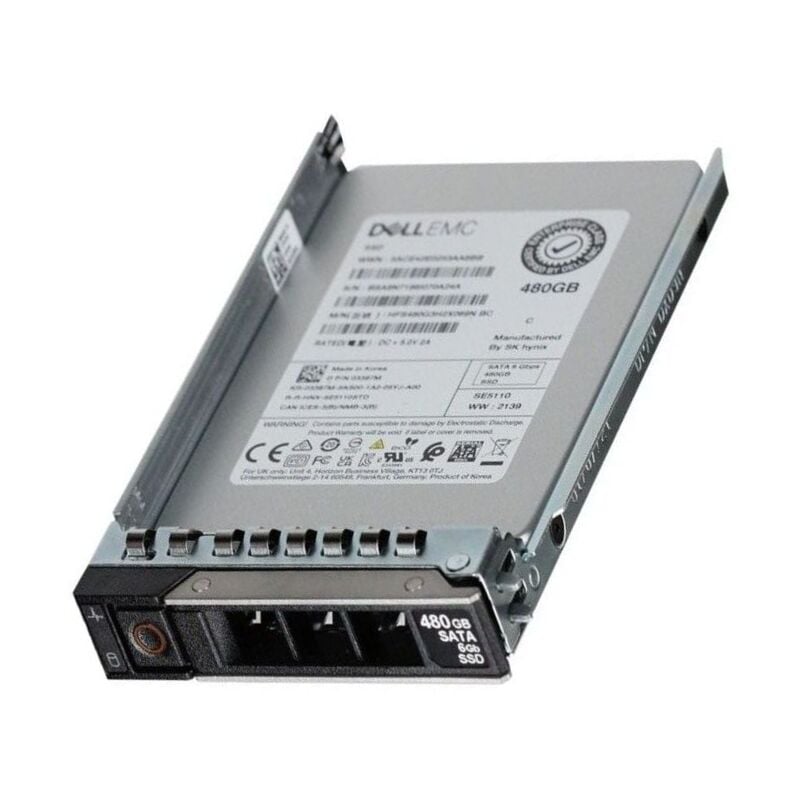
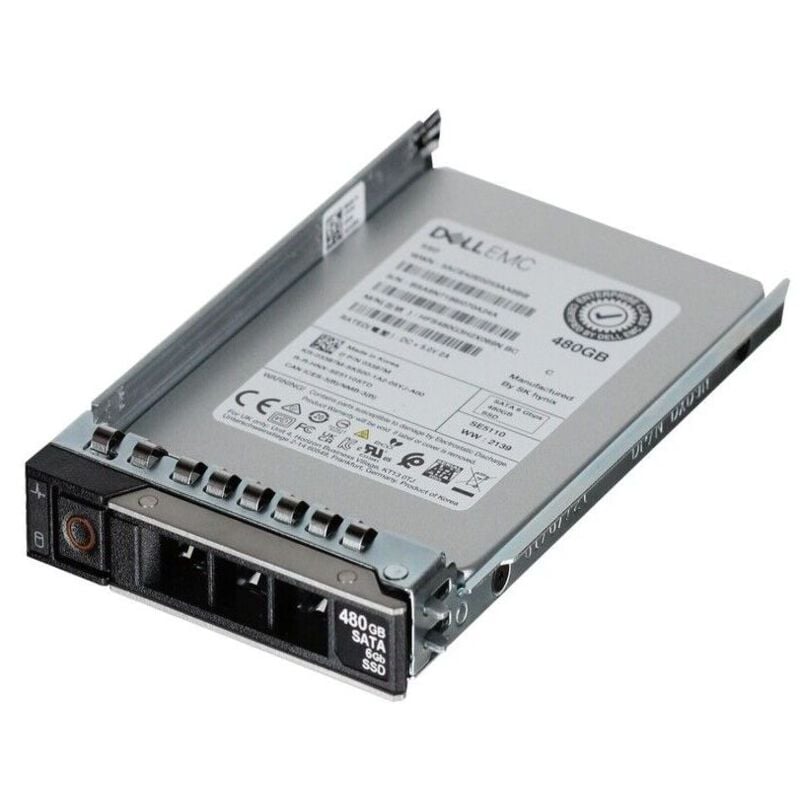
Detail Information about this Dell 400-AXTM
- Manufacturer : Dell
- Model Number or SKU# 400-AXTM
- Product Type : Solid State Drive
- Interface : SATA-6GBPS
Key Features for 480GB Solid State Drive
- Capacity : 480GB SSD
- Form Factor : 2.5inch
- Type : Hot-Swap SSD
Compatibility Information of SATA-6GBPS SSD
- Poweredge R640, Poweredge R740, Poweredge R940
- Poweredge R740xd, Poweredge C6420, Poweredge R440, Poweredge R6415
- Poweredge R7415, Poweredge R7425, Poweredge R840
- Poweredge R940xa, Poweredge R340, Poweredge R6515
- Poweredge R6525, Poweredge R7515, Poweredge C6525, Poweredge R7525
Product Dimensions & Weight
- Height : 0.63 inch
- Width : 3.10 inch
- Depth : 5.45 inch
- Weight : 1.50 lbs
Contact us or ask for live chat/help if you have any questions about the compatibility of this item to ensure the model’s matching features with your current system.


