



Description
Product Overview of the Dell 400-AXTV SSD
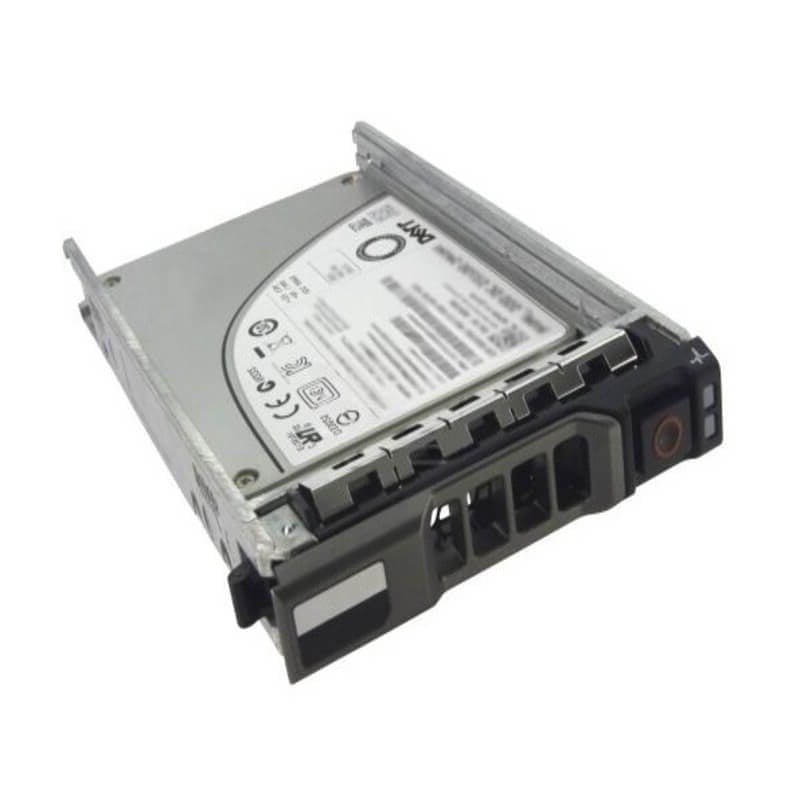
The 400-AXTV is a solid-state drive (SSD) designed by Dell for use in servers. This SSD has a storage capacity of 480 gigabytes (GB) and uses a Serial Advanced Technology Attachment (SATA) interface with a data transfer rate of 6 gigabytes per second (GBPS). It is a read-intensive SSD that uses Triple Level Cell (TLC) technology to store data. This SSD is also hot-pluggable, making it easy to replace in case of failure or upgrades. In this article, we will discuss the features of the 400-AXTV SSD in detail.
Key Features
- Read Intensive: The 400-AXTV is categorized as a Read Intensive Sata 6Gbps SSD. This means it is optimized for scenarios where data retrieval is a primary operation. Such applications include content delivery, web hosting, and data warehousing.
- 2.5-inch Form Factor: With a 2.5-inch form factor, the Dell 400-AXTV is designed to fit seamlessly into server configurations. This compact size enhances compatibility and allows for easy integration into a variety of systems.
- Hot Plug Capabilities: The hot-plug feature enables the SSD to be replaced or added without shutting down the server. This capability minimizes downtime, a crucial aspect in enterprise environments where uninterrupted operation is paramount.
Storage Capacity
The 400-AXTV SSD has a storage capacity of 480 gigabytes (GB). This capacity is sufficient for storing operating systems, applications, and data files. The actual capacity available to the user may be less than 480 GB due to formatting and other factors.
Interface
This SSD uses a Serial Advanced Technology Attachment (SATA) interface to connect to the server’s motherboard. The SATA interface has a data transfer rate of 6 gigabytes per second (GBPS), which provides fast read and write speeds. The SATA interface is also widely used in servers, making it easy to find compatible hardware.
Read-Intensive SSD
The 400-AXTV SSD is designed for read-intensive workloads. This means it is optimized for applications that require more reads than writes. Examples of read-intensive applications include web servers, file servers, and content delivery networks. Read-intensive SSDs have a lower write endurance than write-intensive SSDs because they are designed to handle fewer writes.
Triple Level Cell (TLC) Technology
The 400-AXTV SSD uses Triple Level Cell (TLC) technology to store data. TLC is a type of flash memory that can store three bits of data per cell. This technology allows for a higher storage capacity and lower cost per gigabyte compared to other types of flash memory. However, TLC flash memory has a lower write endurance than other types of flash memory, which is why it is used in read-intensive SSDs.
2.5-Inch Form Factor
The 400-AXTV SSD has a 2.5-inch form factor, which makes it compatible with many servers and storage devices. The 2.5-inch form factor is smaller than the 3.5-inch form factor, which makes it ideal for servers with limited space. The 2.5-inch form factor is also more energy-efficient than the 3.5-inch form factor because it requires less power to operate.
Hot-Pluggable
The 400-AXTV SSD is hot-pluggable, which means it can be replaced while the server is running. This feature allows for easy maintenance and upgrades because the server does not need to be shut down to replace the SSD. Hot-pluggable SSDs are also useful in high-availability environments where downtime is not acceptable.
Compatibility
The 400-AXTV SSD is designed for use in Dell PowerEdge servers. It is compatible with many PowerEdge models, including the PowerEdge R630, R730, R730xd, and T630. However, it is important to check the server’s documentation to ensure compatibility.
General Information about this Dell 400-AXTV
- Manufacturer: Dell
- Model Number or SKU# 400-AXTV
- Product Type: 480GB SATA 6GBPS
- Product Name: Solid State Drive (SSD)
Technical Information for 480GB Solid State Drive
- Form Factor: 2.5inch
- Features: Advanced Format 512e, Read Intensive
- Compatible Bays: Hot-Swap
Performance of Reading Intensive SSD
- Features a non-mechanical design, and is more
shock-resistant. - Faster data access, boot-ups, file transfers, and an overall
quicker computing experience. - Run at near silent operation.
- The flash-based hard drive weighs considerably less.
- The hard drive requires little power to operate, resulting
in less heat output by your system. - More efficient
Compatibility
There are several advantages of SSDs over HDDs (Hard Disk Drives), some of which are:
- Faster performance: SSDs are much faster than HDDs in terms of data access and transfer speeds. They have no moving parts and use flash memory technology to store and access data quickly. This results in faster boot times, faster application launch times, and faster file transfer speeds.
- Improved durability: SSDs are more durable than HDDs as they have no moving parts that can wear out or break over time. This makes them less prone to physical damage and more suitable for use in portable devices.
- Lower power consumption: SSDs consume less power than HDDs, which means they can help extend the battery life of laptops and other portable devices. This also makes them ideal for use in data centers where power consumption is a major concern.
- Quieter operation: SSDs are quieter than HDDs as they have no moving parts that create noise due to spinning disks.
- Higher reliability: SSDs are more reliable than HDDs as they have no moving parts that can fail or cause data loss due to mechanical failure.
- Increased productivity: The faster performance of SSDs can result in increased productivity, as users spend less time waiting for their computers to boot up or applications to load.
- Higher endurance: SSDs have a higher endurance level than HDDs, as they can handle more read/write cycles before they start to degrade. This makes them ideal for applications that require frequent data access.
In Summary, the 400-AXTV SSD is a read-intensive SSD designed by Dell for use in servers. It has a storage capacity of 480 gigabytes (GB) and uses a Serial Advanced Technology Attachment (SATA) interface with a data transfer rate of 6 gigabytes per second (GBPS). It uses Triple Level Cell (TLC) technology to store data and has a 2.5-inch form factor that makes it compatible with many servers. This SSD is also hot-pluggable


