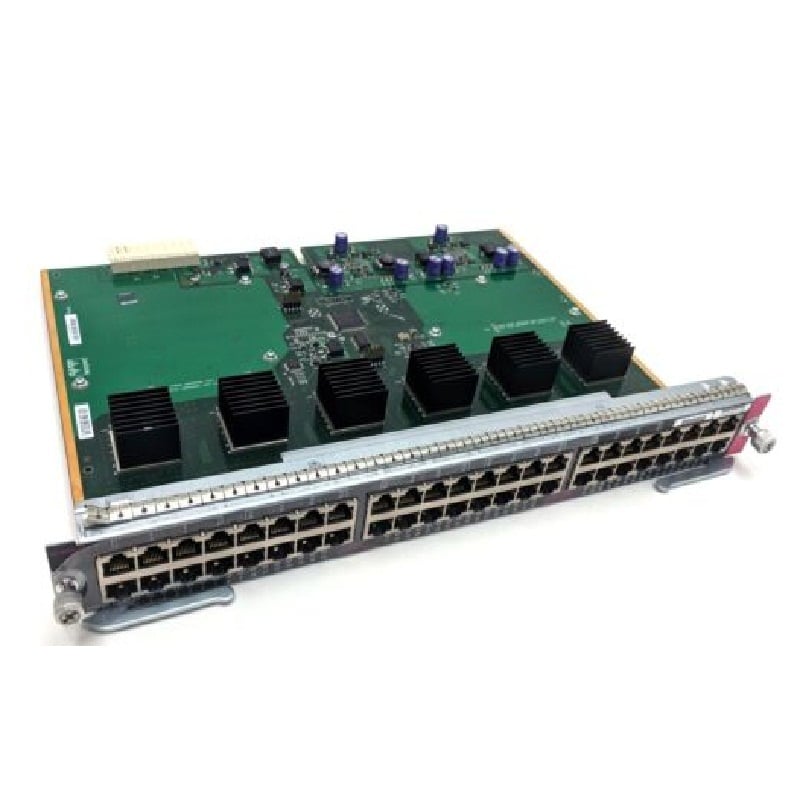


Description
48 Port PoE Configuration
A 48 Port PoE Configuration refers to a network switch that has 48 Ethernet ports, each of which is capable of providing both data and electrical power over a single Ethernet cable. This configuration is particularly useful for powering devices such as wireless access points, IP cameras, and VoIP phones that require a power source but may not be close to a power outlet.
With PoE (Power over Ethernet), the switch supplies power to the connected devices, eliminating the need for separate power cables and wall outlets. This makes installation and maintenance easier, as only one Ethernet cable is required for each device. The 48 Port PoE Configuration allows for a large number of PoE devices to be connected to the network, making it ideal for large and complex networks.
Additionally, the switch may have advanced management capabilities, such as VLAN management, Quality of Service (QoS), and link aggregation, which can improve the efficiency and reliability of the network.
Advanced Management Capabilities
Advanced management capabilities refer to the advanced features and functions of a network device, such as a switch or router, that allow for greater control, monitoring, and configuration of the network. These capabilities may include:
- Network monitoring and reporting: The ability to monitor network traffic, identify bottlenecks, and generate reports on network performance.
- Remote management: The ability to manage the network device remotely, allowing administrators to make changes and troubleshoot issues from a central location.
- Configuration backup and restore: The ability to save and restore configuration settings to quickly restore a device to its previous state in the event of a failure.
- VLAN management: The ability to create and manage virtual local area networks (VLANs), allowing for segmentation of the network and improved security.
- Link aggregation: The ability to group multiple network connections together to increase bandwidth and provide redundancy.
- Quality of Service (QoS): The ability to prioritize network traffic to ensure that critical applications receive the necessary bandwidth and resources.
These advanced management capabilities can greatly improve the efficiency and reliability of a network and are particularly useful for large and complex networks.
Power over Ethernet (PoE)
Power over Ethernet (PoE) is a technology that allows electrical power to be transmitted along with data over standard Ethernet cables. This technology enables powered devices such as phones, cameras, and wireless access points to be powered without the need for a separate power cable, making installation and deployment easier and more flexible.
There are two main types of PoE: standard PoE (IEEE 802.3af) and higher-power PoE (IEEE 802.3at). In both cases, the power is delivered over the same cables as the data, which simplifies installation and reduces cabling costs. The amount of power that can be delivered over PoE depends on the type of PoE, but can range from 15.4W to 90W per port.
The power is supplied by a central device, such as a switch or a midspan injector, and is delivered to end devices such as wireless access points, IP cameras, and VoIP phones.
This eliminates the need for separate power sources for these devices and reduces the number of cables and wall outlets required, making installation and maintenance easier. PoE is commonly used in networking systems where there is limited access to power outlets or where it is difficult to run additional power cables.
General Information about the HPE JG963-61101
- Manufacturer: HPE
- Part Number or SKU# JG963-61101
- Product Type : Networking
- Product Name : 48 Ports Managed Switch
Networking
- Enclosure Type : Rack-Mountable – 1u
- Subtype : Gigabit Ethernet
- Ports : 48 X 10/100/1000 (Poe+) + 2 X 10 Gigabit Ethernet / 1 Gigabit Ethernet Sfp+ + 2 X 10gb Ethernet
- Power Over Ethernet (Poe) : Poe+
- Poe Budget : 370 W
- Performance : Throughput (64-Byte Packet Size) : 130.9 Mpps ¦ Routing/Switching Capacity : 176 Gbps
- Capacity : Ipv4 Routing Table Entries : 32 ¦ Ipv6 Routing Table Entries : 32
- Mac Address Table Size : 16384 Entries
- Jumbo Frame Support : Yes
- Routing Protocol : Igmp, Static Ipv4 Routing, Static Ipv6 Routing
- Remote Management Protocol : Snmp 1, Rmon 2, Snmp 3, Snmp 2c, Http, Https
- Authentication Method : Radius
- Features : Arp Support, Port Mirroring, Half Duplex Mode, Full Duplex Mode, Spanning Tree Protocol (Stp) Support, Virtual Route Redundancy Protocol (Vrrp) Support, Access Control List (Acl) Support, Quality Of Service (Qos), Mld Snooping, Equal-Cost Multipath (Ecmp), Stp Root Guard, Lldp Support, Link Aggregation Control Protocol (Lacp), Packet Storm Protection, Class Of Service (Cos)
- Compliant Standards : Ieee 802.3, Ieee 802.3u, Ieee 802.3i, Ieee 802.3z, Ieee 802.1d, Ieee 802.1q, Ieee 802.3ab, Ieee 802.1p, Ieee 802.3af, Ieee 802.3x, Ieee 802.3ad (Lacp), Ieee 802.1w, Ieee 802.1x, Ieee 802.1s, Ieee 802.1ab (Lldp), Ieee 802.3at
- Ram : 1 Gb – Sdram
- Flash Memory : 128 Mb
Expansion / Connectivity
- 1 X 1000base-T – Rj-45 – Poe+
- 2 X Gigabit / 10gbit Lan – Sfp+
- 2 X 10gbase-T – Rj-45
- 1 X Console – Rj-45 – Management