

Description
Management Interfaces and Protocols
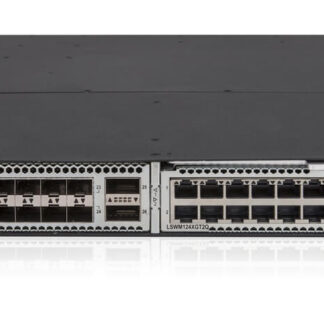
JH178-61001 HPE Flexfabric 5930-2slot+2qsfp+2 Ports Managed Switch is a high-performance switch that provides advanced data center networking capabilities for modern data center environments. It has a total of 2 slots for network modules, 2 quad small form-factor pluggable (QSFP) ports, and 2 standard ports. The switch management interfaces and protocols are designed to make the switch easier to manage, monitor, and configure.
The management interfaces include:
- Web User Interface (Web UI): A graphical user interface that can be accessed through a web browser to manage, monitor, and configure the switch.
- Command Line Interface (CLI): A command-line interface that provides a text-based interface to manage, monitor, and configure the switch.
- Simple Network Management Protocol (SNMP): A standard protocol used for monitoring and managing network devices, including switches.
- Remote Management Interface (RMI): A secure remote management interface that provides a secure way to manage, monitor, and configure the switch from a remote location.
The protocols used by the switch include:
- Link Layer Discovery Protocol (LLDP): A standard protocol used for discovering information about neighboring network devices.
- Routing Information Protocol (RIP): A routing protocol used for exchanging information about network topology.
- Border Gateway Protocol (BGP): A routing protocol used for exchanging information about network topology with other autonomous systems.
- Virtual Router Redundancy Protocol (VRRP): A protocol used for providing redundancy and high availability for virtual routers.
The combination of management interfaces and protocols makes the HPE Flexfabric 5930-2slot+2qsfp+2 Ports Managed Switch a flexible and reliable option for modern data center environments.
Performance and Capacity
The JH178-61001 HPE Flexfabric 5930-2slot+2qsfp+2 Ports Managed Switch is a high-performance, multi-port networking switch designed for use in data centers and other demanding networking environments. This switch provides excellent performance and capacity, enabling it to support high-bandwidth applications, multiple virtual machines, and large-scale networks.
Performance: The JH178-61001 HPE Flexfabric 5930-2slot+2qsfp+2 Ports Managed Switch is equipped with powerful hardware and software features that enable it to deliver outstanding performance. It is powered by a high-speed processor and memory, which provides fast and efficient data processing and forwarding. The switch also supports advanced flow control, congestion management, and Quality of Service (QoS) features, which help to optimize network performance and minimize the risk of data loss or congestion.
Capacity: This switch is capable of supporting up to 2 switch slots and 2 quad small form-factor pluggable (QSFP+) ports, providing a large number of connectivity options for your network. The switch also features a high-capacity, non-blocking switching fabric, which allows it to handle large amounts of data traffic with ease. Additionally, the switch supports advanced network management features, including network monitoring and diagnostics, enabling you to manage your network more efficiently and effectively.
In conclusion, the JH178-61001 HPE Flexfabric 5930-2slot+2qsfp+2 Ports Managed Switch is a powerful and highly capable networking switch that provides excellent performance and capacity for demanding data center and networking environments.
Maintenance and Troubleshooting
The JH178-61001 HPE Flexfabric 5930-2slot+2qsfp+2 Ports Managed Switch requires regular maintenance to ensure its smooth functioning and prevent any performance issues. The following steps can be followed for maintenance and troubleshooting:
- Firmware Updates: The switch firmware should be updated regularly to fix any bugs or security vulnerabilities and improve its performance. The firmware update process can be done through the web interface or using a USB drive.
- Port Configuration: The switch ports should be configured regularly to prevent any issues related to VLANs, Spanning Tree, or Link Aggregation. The port configuration can be done through the web interface or using CLI commands.
- Log Monitoring: The switch log files should be monitored regularly to identify any issues related to network performance, hardware errors, or security threats. The log files can be accessed through the web interface or using CLI commands.
- Power Cycle: If the switch is facing any performance issues, a power cycle can be performed to reset the device and clear any temporary faults.
- Hardware Replacement: If the switch hardware is faulty, it should be replaced with a new one to ensure its smooth functioning.
In case of any troubleshooting, the following steps can be followed:
- Verify the Network Connections: Ensure that the switch is properly connected to the network and the cables are in good condition.
- Check the Configuration: Verify the switch configuration to ensure that it is properly configured and there are no misconfigured settings.
- Monitor the Log Files: Check the log files to identify any issues related to network performance, hardware errors, or security threats.
- Contact HPE Support: If the issue cannot be resolved through the above steps, contact HPE support for further assistance.
General Information about the HP JH178-61001
- Manufacturer: HP
- Part Number or SKU# JH178-61001
- Product Type : Networking
- Product Name : 2 Ports Switch
Technical Specifications
- Enclosure Type : Rack-Mountable – 1u
- Subtype : 40 Gigabit Ethernet
- Ports : 2 X 40 Gigabit Qsfp+
- Performance : Latency (64-Byte Packets) : 1 µS ¦ Throughput : 1071 Mpps ¦ Routing/Switching Capacity : 1.44 Tbps
- Capacity : Virtual Interfaces (Vlans) : 4096 ¦ Ipv4 Routing Table Entries : 120000 ¦ Ipv6 Routing Table Entries : 60000
- Mac Address Table Size : 288k Entries
- Jumbo Frame Support : 10000 Bytes
- Routing Protocol : Ospf, Rip, Bgp-4, Is-Is, Rip-2, Bgp, Igmp, Vrrp, Ospfv3, Static Ipv6 Routing, Ripng, Mpls, Bidirectional Forwarding Detection (Bfd)
- Remote Management Protocol : Snmp 1, Telnet, Snmp 3, Snmp 2c, Ssh
- Authentication Method : Secure Shell (Ssh), Radius, Tacacs, Tacacs+, Secure Shell V.2 (Ssh2)
- Features : Flow Control, Dhcp Support, Arp Support, Port Mirroring, Weighted Round Robin (Wrr) Queuing, Sntp Support, Weighted Fair Queuing (Wfq), Sflow, Virtual Route Redundancy Protocol (Vrrp) Support, Multiple Spanning Tree Protocol (Mstp) Support, Data Center Bridging Exchange (Dcbx) Support, Access Control List (Acl) Support, Quality Of Service (Qos), Committed Access Rate (Car), Device Link Detection Protocol (Dldp) Support, Equal-Cost Multipath (Ecmp), Data Center Bridging (Dcb), Transparent (N_Port Id Virtualization – Npiv) Mode Support, Registered State Change Notification (Rscn) Support, Name Server-Based Zoning, Strict Priority (Sp), Edge Virtual Bridging (Evb), Intelligent Resilient Framework Technology (Irf), Redundant Fans, Reverse Airflow Support, 12.2mb Packet Buffer, Precision Time Protocol (Ptp), Fcoe Support, Rdma Over Converged Ethernet (Roce), Virtual Ethernet Port Aggregator (Vepa), In-Service Software Upgrade (Issu), Fcoe Initialization Protocol (Fip), Deficit Round Robin (Drr), Vxlan Tunnel Endpoints (Vtep) Support
- Compliant Standards : Ieee 802.1d, Ieee 802.1q, Ieee 802.1p, Ieee 802.3x, Ieee 802.3ad (Lacp), Ieee 802.1w, Ieee 802.3ae, Ieee 802.1s, Ieee 802.3ah, Ieee 802.1ag, Ieee 802.1ab (Lldp), Ieee 802.1qbb, Ieee 802.1qaz, Ieee 802.1aq, Ieee 802.3ag
- Ram : 4 Gb – Sdram
- Flash Memory : 1 Gb
Expansion / Connectivity
- Interfaces : 2 X 40gbit Lan – Qsfp+ ¦ 1 X Serial (Console) – Rj-45 ¦ 1 X Management – Rj-45 ¦ 1 X Usb 2.0 – Type A
- Expansion Slots : 2 (Total) / 2 (Free) X Expansion Slot
- Installed Modules Qty (Max) : 0 (Installed) / 2 (Max)