
Description
Existing Network Infrastructure
The existing network infrastructure of an organization plays a critical role in determining the compatibility and performance of the HPE StoreFabric CN1100R Dual Port Converged Network Adapter. Before deploying the CN1100R, it is important to evaluate the organization’s existing network infrastructure to ensure compatibility and identify any potential issues that may affect the performance of the CN1100R.
Some factors to consider when evaluating the existing network infrastructure include:
- Network topology: The network topology refers to the physical and logical layout of the organization’s network, including the types of network devices (e.g., switches, routers, firewalls) and their interconnections. The CN1100R requires a converged network architecture, which may require changes to the existing network topology to support the required traffic types.
- Network protocols: The existing network protocols used by the organization should be evaluated to ensure compatibility with the CN1100R. As mentioned earlier, the CN1100R supports a variety of network protocols, including FCoE, iSCSI, RoCE, and Ethernet. The organization’s existing network protocols should be evaluated to ensure compatibility with the CN1100R.
- Network performance: The performance of the organization’s existing network infrastructure should be evaluated to ensure that it can support the increased bandwidth requirements of the CN1100R. The organization’s existing network devices should be evaluated to ensure that they can support the required traffic types and provide the necessary bandwidth and low latency.
- Network security: The security of the organization’s existing network infrastructure should be evaluated to ensure that it can support the CN1100R’s traffic types and provide the necessary security features. The organization’s existing security policies and procedures should be evaluated to ensure that they can be adapted to support the converged network architecture.
Dual Port Design
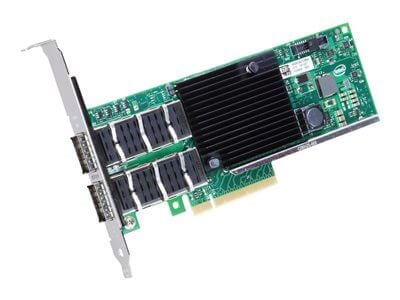
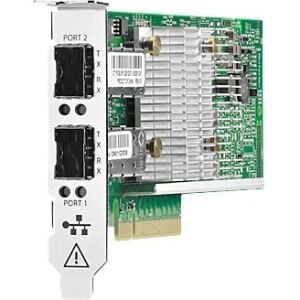
Dual port design refers to the feature of network adapters or network interface cards (NICs) that allows them to have two separate physical ports that can be used to connect to two different networks or devices simultaneously. In the case of the HPE StoreFabric CN1100R Dual Port Converged Network Adapter, this means that it has two ports, each capable of providing up to 10Gbps of bandwidth, for a total potential bandwidth of 20Gbps.
Dual port designs offer several benefits, including redundancy and failover capabilities. By having two physical ports, the adapter can continue to function even if one port fails or is disconnected. This can help to improve network availability and reduce downtime. Additionally, dual port designs can allow for increased network capacity by providing two separate channels of communication between the adapter and the network or devices.
In converged network environments, dual port designs can be particularly useful as they allow for the separation of different types of network traffic. For example, one port could be dedicated to handling storage traffic, while the other port could be used for other types of data traffic, such as video or voice. This can help to improve network performance and reduce latency, as different types of traffic are not competing for the same network resources.
Compatibility Protocols
The HPE StoreFabric CN1100R Dual Port Converged Network Adapter is compatible with a variety of network protocols, enabling it to support different types of network traffic and work with a wide range of network devices. Some of the key compatibility protocols supported by the CN1100R include:
- Fibre Channel over Ethernet (FCoE): FCoE is a protocol that allows Fibre Channel storage traffic to be carried over Ethernet networks, using a converged network architecture. The CN1100R supports FCoE, enabling it to connect to Fibre Channel storage devices and carry Fibre Channel traffic over Ethernet.
- Internet Small Computer System Interface (iSCSI): iSCSI is a protocol that enables block-level storage traffic to be carried over IP networks. The CN1100R supports iSCSI, enabling it to connect to iSCSI storage devices and carry iSCSI traffic over Ethernet.
- Remote Direct Memory Access over Converged Ethernet (RoCE): RoCE is a protocol that enables low-latency, high-bandwidth network connectivity between servers and storage devices in HPC and data center environments. The CN1100R supports RoCE, enabling it to provide low-latency network connectivity between compute nodes and storage resources.
- Data Center Bridging (DCB): DCB is a suite of Ethernet enhancements that provides Quality of Service (QoS) and congestion management capabilities for converged networks. The CN1100R supports DCB, enabling it to provide QoS and congestion management capabilities for converged networks.
- Ethernet: The CN1100R is compatible with standard Ethernet networks, allowing it to connect to a wide range of network devices and carry different types of network traffic.
General Information
- Device Type : Network Adapter
- Form Factor : Plug-In Card
- Interface (Bus) Type : Pci Express 2.0 X8
- Pci Specification Revision : Pci 2.0
Networking:
- Ports : 10gb Ethernet X 2
- Connectivity Technology : Wired
- Cabling Type : Fiber Optic
- Data Link Protocol : 10 GIGE, Fcoe, 10gb Cee
- Data Transfer Rate : 10 GBPS
- Network / Transport Protocol : Iscsi
- Compliant Standards : IEEE 802.1q, IEEE 802.3x, IEEE 802.3ad (Lacp), IEEE 802.3ae, IEEE 802.1as, IEEE 802.1ax, IEEE 802.1qbb, IEEE 802.1qaz, IEEE 802.1qbg, IEEE 802.1qbh
Expansion / Connectivity:
- Interfaces : 2 X 10gbase-Sr – Sfp+