

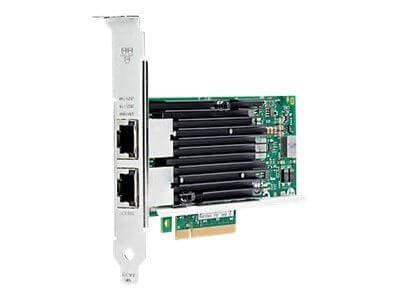
Description
Ethernet Standards Supported
Ethernet is a family of networking technologies that defines the physical and data link layer specifications for wired local area networks (LANs). Over the years, several Ethernet standards have been developed to support different speeds and media types. Some of the Ethernet standards that the HPE Ethernet 10GB 2-Port 561t Adapter supports include:
- 10BASE-T: This was the first Ethernet standard, introduced in the 1980s. It supports data transfer rates of up to 10 Mbps over twisted-pair copper cables.
- 100BASE-TX: This Ethernet standard supports data transfer rates of up to 100 Mbps over twisted-pair copper cables.
- 1000BASE-T: Also known as Gigabit Ethernet, this standard supports data transfer rates of up to 1 Gbps over twisted-pair copper cables.
- 10GBASE-T: This Ethernet standard supports data transfer rates of up to 10 Gbps over twisted-pair copper cables, making it suitable for high-bandwidth applications such as data centers.
- 10GBASE-SR: This standard supports data transfer rates of up to 10 Gbps over multimode fiber optic cables with a maximum distance of 300 meters.
- 10GBASE-LR: This standard supports data transfer rates of up to 10 Gbps over single-mode fiber optic cables with a maximum distance of 10 kilometers.
- 40GBASE-SR4: This standard supports data transfer rates of up to 40 Gbps over multimode fiber optic cables with a maximum distance of 100 meters.
- 40GBASE-LR4: This standard supports data transfer rates of up to 40 Gbps over single-mode fiber optic cables with a maximum distance of 10 kilometers.
- 100GBASE-SR4: This standard supports data transfer rates of up to 100 Gbps over multimode fiber optic cables with a maximum distance of 100 meters.
- 100GBASE-LR4: This standard supports data transfer rates of up to 100 Gbps over single-mode fiber optic cables with a maximum distance of 10 kilometers.
Teaming and Load Balancing
Teaming and Load Balancing are two network configuration techniques that are used to increase network reliability and performance by using multiple network interface controllers (NICs) together.
- NIC Teaming: NIC teaming, also known as network bonding, is a technique used to combine two or more physical NICs into a single logical NIC. By doing this, NIC teaming can provide redundancy and failover in case of a NIC failure, and increase the overall network bandwidth.
There are different types of NIC teaming configurations, including Active/Passive, Active/Active, and Switch Independent. In Active/Passive mode, only one NIC is active at a time, while the other NICs remain in standby mode. In Active/Active mode, all NICs are active and share the network load, providing higher bandwidth and redundancy. In Switch Independent mode, the NIC team is not dependent on the network switch configuration, and the NICs can be connected to different switches.
- Load Balancing: Load balancing is a technique used to distribute network traffic across multiple NICs, providing higher network performance and throughput. Load balancing is achieved by using algorithms to determine the best NIC for each incoming packet.
There are different types of load balancing algorithms, including Round Robin, Hash-based, and Adaptive Load Balancing. In Round Robin, the network traffic is evenly distributed across all available NICs. In Hash-based load balancing, the algorithm uses a hash function to determine the best NIC for each packet based on the source and destination addresses. In Adaptive Load Balancing, the algorithm dynamically adjusts the load distribution based on the NIC utilization and network traffic.
Advanced Networking Features
Advanced networking features are additional capabilities that are provided by network devices such as routers, switches, and network interface controllers (NICs) to enhance network performance, security, and manageability. Some examples of advanced networking features include:
- VLANs: Virtual Local Area Networks (VLANs) allow a network administrator to logically segment a physical LAN into multiple virtual LANs, each with its own broadcast domain. VLANs can increase network security, reduce broadcast traffic, and provide more granular control over network access.
- QoS: Quality of Service (QoS) is a set of technologies and techniques that prioritize network traffic based on its type, source, and destination. QoS can help ensure that critical network traffic, such as voice and video, receive priority over less critical traffic.
- Link Aggregation: Link Aggregation allows multiple physical links between two devices to be combined into a single logical link. This can increase bandwidth and provide redundancy in case of link failure.
- Jumbo Frames: Jumbo Frames are Ethernet frames with a larger Maximum Transmission Unit (MTU) size than the standard 1500-byte Ethernet frame. Jumbo Frames can improve network performance by reducing the number of packets that need to be transmitted and processed.
- Network Security: Advanced networking devices provide various security features such as VPN, firewall, intrusion detection and prevention, and content filtering to protect the network from unauthorized access and malicious attacks.
- Network Monitoring and Management: Advanced networking devices also provide tools for network monitoring and management, such as SNMP, NetFlow, and Syslog. These tools allow network administrators to monitor network performance, troubleshoot issues, and configure devices remotely.
General Information:
- Device Type : Network Adapter
- Form Factor : Plug-In Card
- Interface (Bus) Type : Pci Express 2.1 X8
Networking:
- Ports : 10gb Ethernet X 2
- Connectivity Technology : Wired
- Data Link Protocol : 10 Gigabit Lan
- Data Transfer Rate : 10 GBPS
- Remote Management Protocol : Snmp
- Status Indicators : Port Status, Link Activity
- Features : Jumbo Frames Support, Teaming Support, Pxe Support, Large Send Offload (Lso), Receive Side Scaling (Rss), Tcp Segmentation Offload (Tso)
- Compliant Standards : IEEE 802.3, IEEE 802.3x, IEEE 802.3ad (Lacp), IEEE 802.1ax, IEEE 802.1qbb, IEEE 802.1qaz, IEEE 802.1qau
Expansion / Connectivity:
- Interfaces : 2 X 10gb Ethernet – Rj-45


