

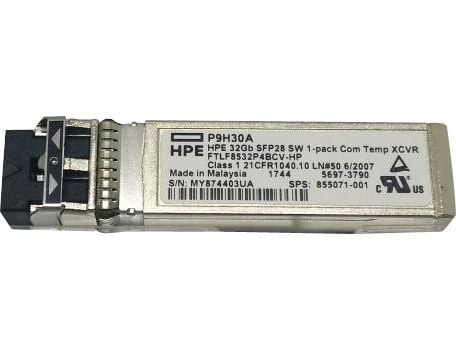
Description
Fibre Channel Standards and Speeds
Fibre Channel (FC) is a high-speed network technology that is commonly used in data storage and networking environments. The Fibre Channel standard defines various speeds and protocols that enable the transfer of data over fiber-optic cables. The HPE 855071-001 32G Fibre Channel (32GFC) Short-Wavelength SFP+ Optical Transceiver is designed to work with Fibre Channel networks operating at 32Gbps.
Each Fibre Channel standard has its own advantages and limitations. The newer standards generally offer higher bandwidth and faster data transfer rates, which can improve the performance of Fibre Channel networks. The 32GFC standard, which is supported by the HPE 855071-001 transceiver, provides a maximum data transfer rate of 32Gbps, which is twice the speed of the previous 16GFC standard.
It is worth noting that the speed of a Fibre Channel network is determined not only by the speed of the transceivers, but also by the speed of the switches and other network components. In order to achieve the maximum data transfer rate of 32Gbps with the HPE 855071-001 transceiver, all other components in the Fibre Channel network must also support the 32GFC standard.
The Fibre Channel standard defines various speeds and protocols that enable the transfer of data over fiber-optic cables. The HPE 855071-001 32GFC Short-Wavelength SFP+ Optical Transceiver is designed to work with Fibre Channel networks operating at 32Gbps, which is the fastest speed currently available for Fibre Channel networks.
Advantages of Short Wavelength Optical Transceiver
Short-wavelength optical transceivers, such as the HPE 855071-001 32G Fibre Channel (32GFC) Short-Wavelength SFP+ Optical Transceiver, offer several advantages over other types of optical transceivers.
- Lower Cost: Short-wavelength optical transceivers are generally less expensive than their long-wavelength counterparts. This is because they use less expensive optical components and require less stringent manufacturing processes.
- Higher Bandwidth: Short-wavelength optical transceivers can support higher bandwidths compared to other types of optical transceivers. This is because they can transmit data at higher frequencies, which allows for more data to be transmitted in a given amount of time.
- Compatibility: Short-wavelength optical transceivers are compatible with a wider range of fiber types, including multimode fibers. This makes them a more versatile option for use in different types of networks.
- Lower Power Consumption: Short-wavelength optical transceivers generally require less power to operate compared to other types of transceivers. This can help to reduce energy costs and improve the overall energy efficiency of a network.
- Distance Limitations: While long-wavelength optical transceivers can transmit data over longer distances, short-wavelength transceivers are typically used for shorter distances. However, this can be an advantage in certain applications where shorter distances are required, such as in data centers or storage area networks.
Short-wavelength optical transceivers offer several advantages over other types of optical transceivers, including lower cost, higher bandwidth, compatibility with a wider range of fiber types, lower power consumption, and suitability for use in shorter-distance applications. The HPE 855071-001 32GFC Short-Wavelength SFP+ Optical Transceiver is designed to provide these advantages and is a versatile option for use in a range of different networks and applications.
Installation and Configuration
The installation and configuration process for the HPE 855071-001 32G Fibre Channel (32GFC) Short-Wavelength SFP+ Optical Transceiver may vary depending on the specific network and equipment it is being used with. However, here are some general steps that may be involved in installing and configuring the transceiver:
- Ensure that the network equipment, including switches and routers, are powered off and disconnected from their power source.
- Locate the SFP+ port on the network equipment and insert the transceiver into the port. Be sure to align the transceiver with the port correctly and gently push the transceiver until it clicks into place.
- Connect the fiber optic cable to the transceiver. Depending on the cable and equipment, this may involve removing protective caps or covers from the cable and the transceiver port.
- Power on the network equipment and allow it to fully initialize. The transceiver should be automatically detected and recognized by the equipment.
- Configure the transceiver settings as needed. This may include setting the speed, bandwidth, and other parameters to ensure proper performance.
- Test the network connection to ensure that the transceiver is functioning properly. This may involve using diagnostic tools to check for errors, signal strength, and other indicators of performance.
- Monitor the transceiver and network performance over time to ensure that it is operating as expected. This may involve regular maintenance and updates to the network equipment and software.
It is important to follow manufacturer instructions and safety guidelines when installing and configuring the HPE 855071-001 transceiver. In addition, it may be helpful to consult with an experienced network technician or IT professional to ensure proper installation and configuration of the transceiver and network equipment.
General Information
- Manufacturer: HPE
- Part Number or SKU# 855071-001
- Product Type : Transceiver
Technical Information
- Up To 28.05 Gb/S Bi-Directional Data Links
- Hot-Pluggable SFP+ Footprint
- 850nm Oxide Vcsel Laser Transmitter
- Duplex Lc Connector
- Rohs Compliant
- 100M Over M5f MMF (50/125 UM OM4)
- 70M Over M5e MMF (50/125UM OM3)
- 20M ON 50 Mm (Om2) Mmf
- Metal Enclosure, For Lower Emi
- Single 3.3V Power Supply
- Operating Temperature Range: 0°C To 70°C


