

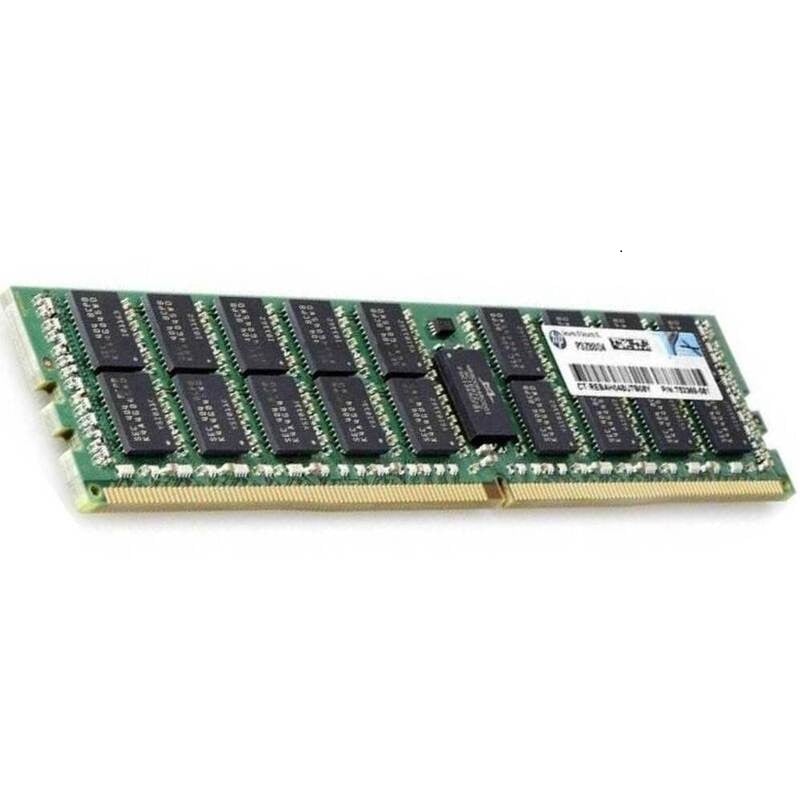


Description
Benefits of using ECC Registered DDR4 SDRAM
There are several benefits to using ECC Registered DDR4 SDRAM:
- Improved data integrity: ECC memory uses error-correction codes to detect and correct errors that can occur in data as it is stored or transmitted, which helps to ensure that the data is accurate and free from corruption.
- Increased reliability: ECC memory is able to detect and correct single-bit errors, which can reduce the likelihood of system crashes and data loss.
- Enhanced performance: ECC memory is able to detect and correct errors in real-time, which can improve system performance by reducing the need for error checking and correction.
- Better power efficiency: ECC memory is designed to consume less power than non-ECC memory, which can help to reduce energy costs and extend the life of the system.
- Suitable for mission-critical applications: ECC memory is commonly used in servers, databases, and other mission-critical applications where data integrity is of the utmost importance.
- Registered DDR4 SDRAM: The registered version provides greater number of memory devices per channel, which leads to increased memory density and scalability in servers and workstations.
How ECC improves Memory Reliability
ECC (Error Correction Code) improves memory reliability by detecting and correcting errors that can occur in data as it is stored or transmitted. ECC uses a technique called parity checking, which involves adding an extra bit of data to each byte of memory. This extra bit, called a parity bit, is used to create a code that can be used to detect and correct errors.
When data is written to memory, the ECC algorithm calculates the parity bit and stores it along with the data. When the data is read from memory, the ECC algorithm recalculates the parity bit and compares it to the stored parity bit. If the two values do not match, it indicates that an error has occurred and the ECC algorithm can correct the error by using the stored parity bit to determine the correct value of the data.
ECC memory is able to detect and correct single-bit errors, which can reduce the likelihood of system crashes and data loss. Additionally, ECC memory is able to detect and correct errors in real-time, which can improve system performance by reducing the need for error checking and correction.
ECC memory is also more robust to data corruption caused by soft errors, which are errors caused by environmental factors such as cosmic rays and power fluctuations. This makes ECC memory a good choice for use in servers, databases, and other mission-critical applications where data integrity is of the utmost importance.
How Registered Memory Improves System Performance
Registered memory (also known as buffered memory) improves system performance by adding a register between the memory controller and the memory modules. This register acts as a buffer, allowing the memory controller to communicate with multiple memory modules at the same time.
By buffering the communication between the memory controller and the memory modules, registered memory can increase the number of memory devices that can be used in a system without overloading the memory controller. This leads to increased memory density and scalability in servers and workstations, which can help to improve system performance by providing more memory resources for the system to use.
Additionally, registered memory helps to improve data integrity by providing a mechanism for the memory controller to communicate with each memory module individually. This allows the memory controller to identify and correct errors that may occur in the memory, which can help to reduce the likelihood of system crashes and data loss.
Registered memory is typically used in servers, workstations, and other high-performance systems where memory density and data integrity are of the utmost importance.
General Information
- Manufacturer: HPE
- Manufacturer Part Number: 868844-001
- Type: Memory (RAM)
- Sub-Type: PC4-21300
- Product Name: 64GB DDR4 SDRAM Memory Module
Technical Information
- Storage Capacity: 64GB
- Memory Technology: DDR4 SDRAM
- Number Of Modules: 1 X 64GB
- Bus Speed: 2666mhz DDR4-21300/PC4-2666v
- Data Integrity Check: ECC
- Signal Processing: Registered
- Cas Latency Timings: Cl19
- Rank Features: 4rx4
Compatibility
- HPE Proliant Dl580 Gen10 Server
- HPE Proliant Dl380 Gen10 Server
- HPE Proliant Dl360 Gen10 Server
- HPE Proliant Dl560 Gen10 Server
- HPE Proliant Ml350 Gen10 Server
- HPE Proliant Ml110 Gen10 Server
- HPE Proliant Xl190r Gen10 Server
- HPE Compute Modules
- Synergy 660 Gen10
- Synergy 480 Gen10


