

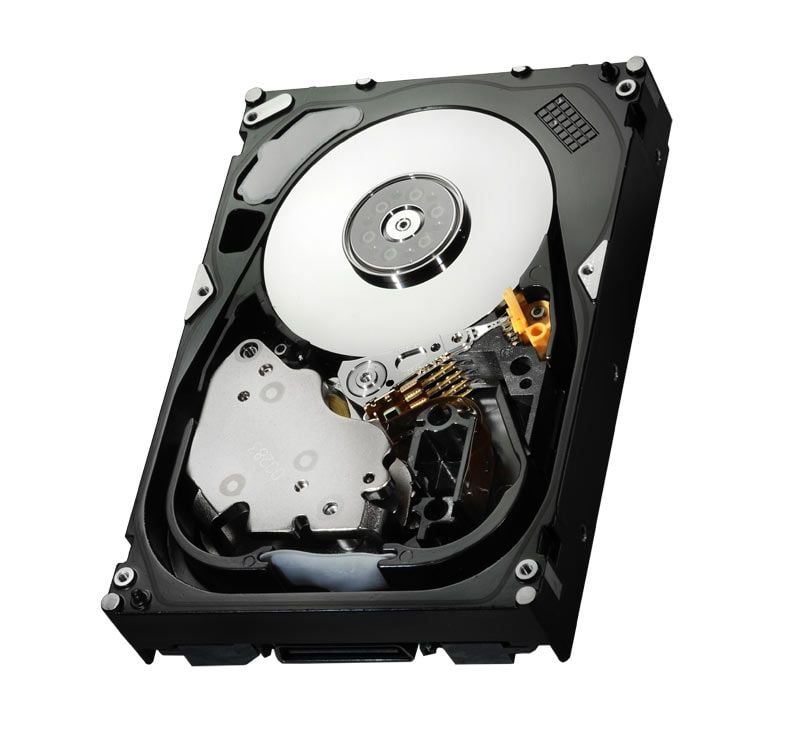

Description
Speed and Performance of the Drive
The speed and performance of a hard drive are important factors to consider when selecting a drive for a computer system. The speed of a hard drive is typically measured in revolutions per minute (RPM), while performance is measured in terms of data transfer rates, seek times, and latency.
The BD400DADFQ is a high-performance hard drive with a spindle speed of 10,000 RPM. This means that the drive can read and write data faster than a drive with a lower RPM, leading to improved performance. Higher RPM also reduces the average seek time of the drive, which means that the drive can locate and access data more quickly.
In addition to spindle speed, the drive also supports a 4Gbps Fibre Channel interface, which enables fast data transfer rates. The Fibre Channel interface is designed for use in enterprise-level storage systems and is known for its reliability and scalability.
The drive also features dual port connectivity, which means that it can be connected to two different host systems simultaneously. This feature allows for load balancing and failover, improving overall performance and reliability.
The performance of the drive can be further enhanced through the use of features such as command queuing and caching. Command queuing allows the drive to handle multiple I/O requests simultaneously, while caching allows frequently accessed data to be stored in the drive’s cache memory for faster access.
10K RPM Spindle Speed and Its Benefits
The spindle speed of a hard drive refers to the speed at which the disks inside the drive rotate. A higher spindle speed means that the drive can read and write data faster, leading to improved performance. The BD400DADFQ hard drive has a spindle speed of 10,000 RPM, which offers several benefits:
- Faster data access: The faster the spindle speed, the faster the drive can read and write data. This means that the BD400DADFQ can access data more quickly than a drive with a lower spindle speed, leading to improved performance.
- Improved seek times: The time it takes for a drive to locate and access data is known as the seek time. A higher spindle speed can reduce the average seek time of a drive, allowing it to locate and access data more quickly.
- Better performance in high-workload environments: A higher spindle speed can help a drive handle heavy workloads more efficiently. This is especially important in environments such as datacenters, where large amounts of data need to be processed quickly.
- Improved performance for data-intensive applications: Applications that require a lot of data processing, such as video editing or scientific simulations, can benefit from a drive with a higher spindle speed. This is because the drive can read and write data more quickly, reducing the time it takes to complete tasks.
- Higher throughput: The higher the spindle speed, the higher the data transfer rates of the drive. This means that the BD400DADFQ can transfer data more quickly than a drive with a lower spindle speed, making it ideal for use in high-performance computing environments.
Fibre Channel Technology and How It Works
Fibre Channel (FC) is a high-speed data transfer technology that is commonly used in enterprise-level storage systems. It is designed to provide reliable, high-bandwidth connectivity between servers, storage devices, and other network components. Here’s how Fibre Channel works:
- Physical connectivity: Fibre Channel uses optical or copper cables to connect devices. Optical cables use light to transmit data, while copper cables use electrical signals. Fibre Channel cables typically have two or more fibers or wires, enabling bidirectional communication.
- Protocol: Fibre Channel uses a protocol stack to transmit and receive data. The protocol stack is divided into five layers, each of which has a specific function. The layers are the physical layer, the data link layer, the network layer, the transport layer, and the application layer.
- Topology: Fibre Channel can be configured in different topologies, including point-to-point, arbitrated loop, and switched fabric. Point-to-point is a simple, direct connection between two devices. Arbitrated loop is a shared loop topology that connects multiple devices. Switched fabric is a more complex topology that uses switches to connect devices, enabling multiple simultaneous connections.
- Bandwidth: Fibre Channel supports high-bandwidth connections, with data transfer rates ranging from 1 Gbps to 128 Gbps. The bandwidth can be increased by using multiple Fibre Channel connections in parallel.
- Reliability: Fibre Channel is designed to be highly reliable, with built-in features such as error detection and correction, flow control, and redundancy. These features help to ensure that data is transferred accurately and reliably.
General Information
- Manufacturer: HP
- Manufacturer Part Number: BD400DADFQ
- Type: Hard Drive(HDD)
- Sub-Type: Fibre Channel
Performance
- Product Type: Internal Hard Drive
- Form Factor: 3.5-inch
- Capacity: 400 GB
- Spindle Speed: 10K RPM
- Drive Interface Type: Fibre Channel 4 GBPS


