

Description
Management and Security
“Management and Security” is a critical aspect of the HPE JD994-61101 Baseline V1905-48 Managed EN Fast 48 Ports Switch. This section would likely cover the different features and capabilities that the switch has to secure and manage the network.
The switch has a variety of management features that allow network administrators to monitor, configure, and control the switch remotely. This can be done through a web-based graphical user interface (GUI), a command-line interface (CLI), or through a network management system (NMS) that uses SNMP.
The switch also has several security features that can help to protect the network from unauthorized access and malicious attacks. Some of these features include:
- Access control lists (ACLs): ACLs are used to control access to the switch and to specific resources on the network. They can be used to block traffic from specific IP addresses or to limit access to specific ports on the switch.
- Virtual LANs (VLANs): VLANs are used to segment a network into smaller, virtual networks. This can help to improve security by isolating different types of traffic and limiting access to specific resources.
- 802.1X authentication: The switch supports 802.1X authentication, which is a widely-used standard for network authentication. This allows the switch to authenticate users or devices before they are allowed to access the network.
- Port security: The switch has the ability to limit the number of MAC addresses that can be learned on a port, and also to configure the switch to take an action when the maximum number is exceeded.
- SSH and SSL: The switch supports both SSH and SSL encryption, which can be used to secure communication between the switch and remote management systems.
- IP Source Guard: IP Source Guard is a security feature that can be used to prevent unauthorized IP addresses from being learned on a switch port.
- DHCP Snooping: DHCP Snooping is a security feature that can be used to prevent unauthorized DHCP servers from providing IP addresses to clients on a LAN.
- TACACS+: The switch supports TACACS+ which is an authentication protocol that allows a network access server to forward a user’s logon credentials to an authentication server to determine whether access should be allowed to the requested network resources.
All these features help to secure the network and provide a level of control over who can access the network and what they can do once they are connected. Additionally, the switch also supports HPE’s Intelligent Management Center (IMC), which is a network management software that provides centralized management and monitoring of network devices, including the HPE JD994-61101 Baseline V1905-48 Managed EN Fast 48 Ports Switch. It allows for real-time monitoring of the switch’s performance and usage, and provides detailed reports and alerts, giving more visibility and control over the network.
Layer 3 Switching Capabilities
“Layer 3 Switching Capabilities” is an important aspect of the HPE JD994-61101 Baseline V1905-48 Managed EN Fast 48 Ports Switch. This section would likely cover the different features and capabilities that the switch has for performing Layer 3 switching.
The HPE JD994-61101 Baseline V1905-48 Switch is a Layer 3 switch, which means that it can perform routing functions in addition to traditional Layer 2 switching functions. This allows the switch to forward packets based on their destination IP address, rather than just their destination MAC address.
The switch supports a variety of routing protocols, including:
- Routing Information Protocol (RIP)
- Open Shortest Path First (OSPF)
- Border Gateway Protocol (BGP)
- Intermediate System to Intermediate System (IS-IS)
These routing protocols allow the switch to dynamically learn about the network topology and to make intelligent decisions about how to forward packets.
The switch also supports Virtual Routing and Forwarding (VRF), which allows the switch to create multiple virtual routing tables and to route packets between them. This can be useful in situations where different parts of the network need to be isolated from each other.
The switch also has advanced security features such as IP Source Guard, DHCP Snooping and Access Control List (ACL) which can be used to secure and control access to the network.
Additionally, the switch supports Quality of Service (QoS) features, which can be used to prioritize different types of traffic. This can be useful in situations where certain types of traffic, such as voice or video, need to be given priority over other types of traffic.
All these features allow the HPE JD994-61101 Baseline V1905-48 Switch to provide powerful Layer 3 switching capabilities, providing advanced routing and security features and allowing you to segment your network and control access to your network resources.
Quality of Service (QoS)
Quality of Service (QoS) is a feature of the HPE JD994-61101 Baseline V1905-48 Managed EN Fast 48 Ports Switch that allows network administrators to prioritize different types of traffic. This can be useful in situations where certain types of traffic, such as voice or video, need to be given priority over other types of traffic.
The switch supports a variety of QoS features, including:
- Class of Service (CoS)
- Differentiated Services Code Point (DSCP)
- Weighted Random Early Detection (WRED)
- Traffic shaping and policing
CoS and DSCP allow network administrators to assign a priority level to different types of traffic. This allows the switch to give priority to certain types of traffic, such as voice or video, over other types of traffic.
WRED allows the switch to randomly drop lower priority traffic when the network becomes congested, in order to prevent higher priority traffic from being affected.
Traffic shaping and policing features allow the switch to control the rate at which traffic is sent and received, which can help prevent the network from becoming overloaded.
All these features allow the HPE JD994-61101 Baseline V1905-48 Switch to provide powerful Quality of Service (QoS) capabilities, providing network administrators with the ability to prioritize different types of traffic and to ensure that critical applications get the bandwidth they need.
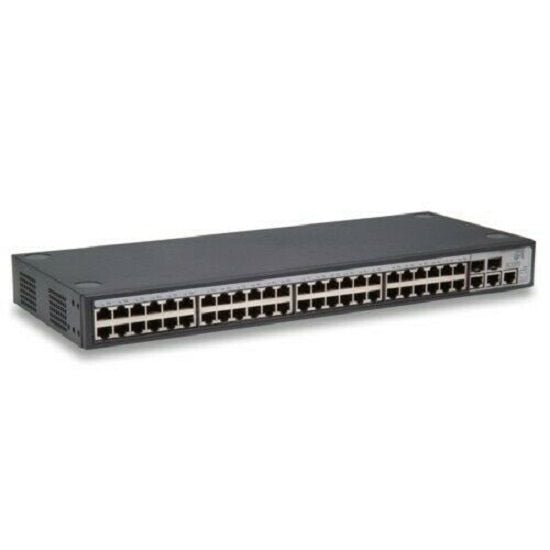
Details Information about the HPE JD994-61101
- Manufacturer : HPE
- Model Number or SKU# JD994-61101
- Device Type : Switch – 48 Ports – Managed
- Enclosure Type : Rack-Mountable – 1U
- Ports : 48 X 10/100 + 2 X Combo Gigabit SFP
- Routing Protocol : Igmp
- Remote Management Protocol : Rmon 2, Snmp, Http
- Encryption Algorithm : Ssl
- Authentication Method : Radius
- Features : Flow Control, Layer 2 Switching, Trunking, Vlan Support, Auto-Uplink (Auto Mdi/Mdi-X), Port Mirroring, Manageable, Spanning Tree Protocol (Stp) Support, Rapid Spanning Tree Protocol (Rstp) Support, Access Control List (Acl) Support, Quality Of Service (Qos)
- Compliant Standards : IEEE 802.3, IEEE 802.3U, IEEE 802.3I, IEEE 802.3Z, IEEE 802.1D, IEEE 802.1Q, IEEE 802.3AB, IEEE 802.1P, IEEE 802.3X, IEEE 802.3AD (LACP), IEEE 802.1W, IEEE 802.1X, IEEE 802.3AE, IEEE 802.3AC, IEEE 802.1S, IEEE 802.1AB (LLDP)
- Processor : 1 X Arm : 150 Mhz
- Ram : 8 Mb – Sdram
- Flash Memory : 4 Mb
Expansion / Connectivity
- Interfaces : 48 X 10Base-T/100Base-Tx – RJ-45 2 X 10Base-T/100Base-Tx/1000base-T- RJ-45 1 X Console – RJ-45 – Management 2 X Sfp (Mini-Gbic)
Power
- Voltage Required : Ac 120/230 V ( 50/60 Hz )