

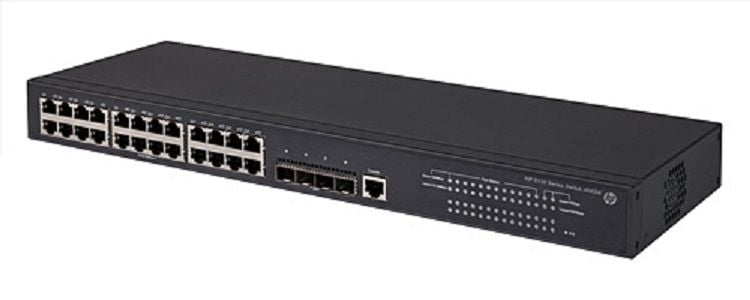
Description
Quality of Service (QoS)
Quality of Service (QoS) is a network management technique that prioritizes different types of network traffic based on their importance, allowing critical applications and services to receive the necessary bandwidth and resources they need to operate effectively. Some of the key features and benefits of QoS in the context of the HPE 5130-24G-4SFP+ switch include:
- Traffic prioritization: QoS allows administrators to prioritize different types of traffic, such as voice and video, to ensure that they receive the necessary bandwidth and resources.
- Improved performance: By ensuring that critical applications and services receive the necessary bandwidth and resources, QoS can help to improve their performance and prevent network congestion.
- Enhanced reliability: By prioritizing critical traffic, QoS can help to ensure that important services and applications remain available and reliable even when the network is congested.
- Efficient use of network resources: By allocating bandwidth and resources to the most important traffic, QoS helps to ensure that the network is used efficiently, reducing the risk of network congestion and improving overall network performance.
The QoS features of the HPE 5130-24G-4SFP+ switch allow administrators to improve the performance and reliability of their network, and to prioritize critical applications and services, ensuring that they receive the necessary bandwidth and resources they need to operate effectively.
Management and Configuration
“Management and Configuration” refers to the ways in which the HPE 5130-24G-4SFP+ switch can be managed and configured to meet the needs of a network. This may include:
- Web GUI: A web-based graphical user interface (GUI) that allows administrators to access and manage the switch through a web browser.
- CLI: A command-line interface (CLI) that allows administrators to access and manage the switch through a terminal or console.
- SNMP: Simple Network Management Protocol (SNMP) support that allows the switch to be managed and monitored using network management software.
- Auto-configuration: Automated setup and configuration of the switch, including basic network settings and port configurations.
- Firmware updates: The ability to update the switch’s firmware to the latest version to ensure optimal performance and security.
- Configuration backup and restore: The ability to save and restore switch configurations to ensure that settings are not lost in the event of a failure.
- Port mirroring: The ability to mirror network traffic from one port to another for analysis and troubleshooting purposes.
- Port aggregation: The ability to combine multiple physical ports into a single logical link to increase bandwidth and provide redundancy.
These management and configuration features allow administrators to easily set up, monitor, and manage the HPE 5130-24G-4SFP+ switch to meet the needs of their network.
Regulatory Compliance
Regulatory compliance refers to the process of ensuring that a product, such as the HPE 5130-24G-4SFP+ switch, meets the standards and regulations set by government and industry organizations. Some common compliance requirements include:
- Safety certifications: certifications such as UL or CE that ensure that the switch meets safety standards for electrical and fire safety.
- EMC emissions: requirements for electromagnetic compatibility (EMC) emissions to prevent interference with other devices and ensure that the switch meets international EMC standards.
- RoHS compliance: compliance with the Restriction of Hazardous Substances (RoHS) directive, which restricts the use of hazardous materials in electronic products.
- WEEE compliance: compliance with the Waste Electrical and Electronic Equipment (WEEE) directive, which requires the proper disposal and recycling of electronic waste.
- Network security standards: compliance with network security standards such as FIPS 140-2, which sets minimum security requirements for cryptographic modules.
- Environmental regulations: compliance with regulations such as Energy Star, which sets energy efficiency requirements for electronic products.
- Industry standards: compliance with industry standards such as IEEE 802.3, which sets standards for Ethernet networks.
Ensuring that the HPE 5130-24G-4SFP+ switch meets these compliance requirements helps to ensure that it operates safely, securely, and efficiently, and helps to protect the environment.
Main Specification about the HPE JG932A#ABA
- Manufacturer: HPE
- Part Number or SKU # JG932A#ABA
- Device Type: Managed Switch
Technical Information
- Enclosure Type : Rack-Mountable – 1u
- Subtype : Gigabit Ethernet
- Ports : 24 X 10/100/1000 + 4 X 10 Gigabit Ethernet / 1 Gigabit Ethernet Sfp+
Performance
- Throughput : 96 Mpps, Routing/Switching Capacity : 128 Gbps
- Capacity : Ipv4 Routing Table Entries : 512, Ipv6 Routing Table Entries : 256
- Mac Address Table Size : 16k Entries
- Jumbo Frame Support : 9216 Bytes
- Routing Protocol : Static Ipv4 Routing, Static Ipv6 Routing
- Remote Management Protocol : Snmp 1, Rmon 1, Rmon 2, Rmon 3, Rmon 9, Snmp 3, Snmp 2c, Http, Https, Cli
- Encryption Algorithm : Ssl
- Authentication Method : Radius, Tacacs+, Secure Shell V.2 (Ssh2), Hwtacacs
Features
- Dhcp Support, Arp Support, Vlan Support, Auto-Uplink (Auto Mdi/Mdi-X), Igmp Snooping, Weighted Round Robin (Wrr) Queuing, Ipv6 Support, Sflow, Rapid Spanning Tree Protocol (Rstp) Support, Multiple Spanning Tree Protocol (Mstp) Support, Access Control List (Acl) Support, Quality Of Service (Qos), Jumbo Frames Support, Mld Snooping, Per-Vlan Spanning Tree Plus (Pvst+), Device Link Detection Protocol (Dldp) Support, Rapid Ring Protection Protocol (Rrpp) Support, Endpoint Admission Defense (Ead), Stp Root Guard, Lldp Support, Dhcp Relay, Port Security, Dynamic Arp Protection, Dhcp Protection, Strict Priority Queuing (Spq), Port Isolation, Tagged Vlan, Generic Attribute Registration Protocol (Garp), Intelligent Resilient Framework Technology (Irf)
- Ram : 1 Gb – Sdram
- Flash Memory : 128 Mb
Expansion / Connectivity
- Interfaces 24 X 1000base-T – Rj-45, 4 X Gigabit / 10gbit Lan – Sfp+, 1 X Console – Rj-45 – Management
Power
- Power Device : Internal Power Supply
- Voltage Required : Ac 120/230 V
- Power Consumption Operational : 26 Watt


