
Description
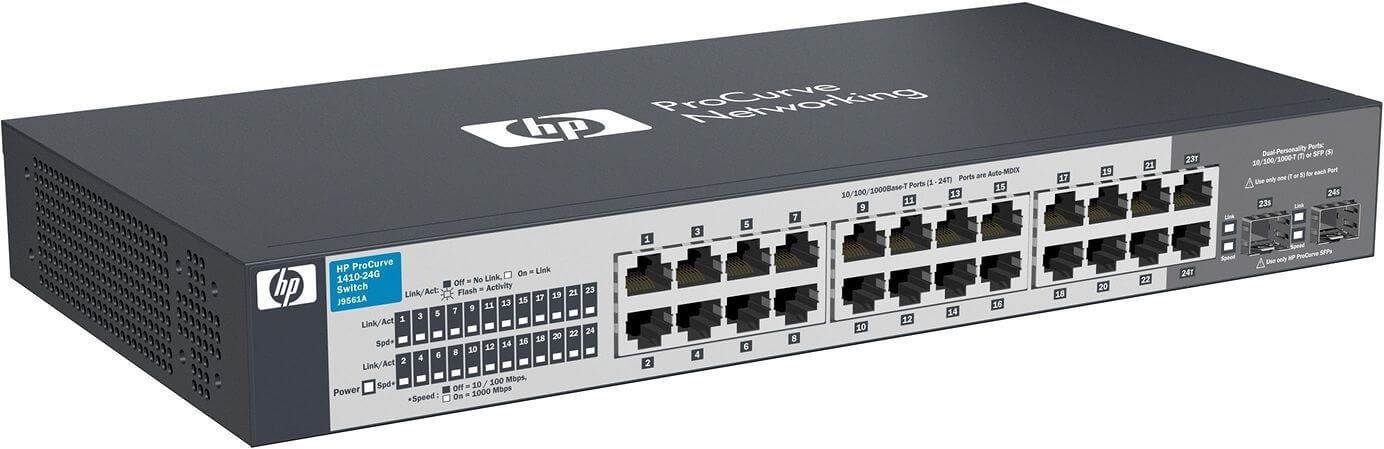
24 Gigabit Ethernet Ports
The 24 Gigabit Ethernet ports refer to a feature of the HPE Aruba 2930M switch. A Gigabit Ethernet port is a type of Ethernet port that supports data transfer rates of up to 1 gigabit per second (1 Gbps). In the case of the HPE Aruba 2930M switch, there are 24 such ports available, allowing for up to 24 devices to be connected to the switch at once.
Each of these Gigabit Ethernet ports can be used to connect devices such as computers, servers, printers, and other network-enabled devices. The high data transfer rate of the Gigabit Ethernet ports enables fast and efficient communication between these devices.
The presence of 24 Gigabit Ethernet ports on the HPE Aruba 2930M switch makes it well-suited for medium-sized networks and data centers that require high-speed connectivity for multiple devices. Additionally, the Gigabit Ethernet ports provide the bandwidth necessary for supporting high-bandwidth applications, such as video conferencing, online gaming, and large file transfers.
Virtual LANs (VLANs) Support
Virtual LANs (VLANs) are a technology used to segment a physical network into logical sub-networks. In other words, VLANs allow you to divide a single physical network into multiple virtual networks, each with its own broadcast domain.
The HPE JL319-61001 Aruba 2930M switch supports VLANs, meaning that it has the capability to create and manage virtual LANs within the physical network. This provides several benefits, including:
- Improved security: By segmenting the network into separate virtual LANs, you can reduce the risk of unauthorized access to sensitive data and resources.
- Better network performance: By dividing the network into smaller, more manageable segments, you can improve network performance by reducing the amount of broadcast traffic.
- Increased flexibility: With VLANs, you can easily move devices from one virtual network to another without having to physically move them or reconfigure the network.
- Simplified network management: VLANs can simplify network management by allowing you to configure and manage multiple virtual networks from a single switch.
In short, VLANs provide a flexible and efficient way to segment a physical network into multiple virtual networks, and the support for VLANs on the HPE Aruba 2930M switch makes it a good choice for organizations that require this type of network segmentation.
Troubleshooting and Maintenance
Troubleshooting and maintenance are essential aspects of managing a network and ensuring its smooth functioning.
Troubleshooting refers to the process of identifying and fixing issues that arise in a network. It is a systematic approach to isolate and diagnose problems, and then implement solutions to resolve them. Some common troubleshooting tasks include identifying connectivity issues, resolving performance problems, and fixing security issues.
Maintenance, on the other hand, refers to regular and preventative measures taken to keep a network running smoothly. It includes tasks such as software and firmware updates, backups, and hardware replacements. Regular maintenance can help to prevent problems from arising and can also help to extend the life of network equipment.
For the HPE Aruba 2930M Switch, troubleshooting and maintenance tasks can be performed using the web-based graphical user interface (GUI) or the command-line interface (CLI). The switch also provides diagnostic and troubleshooting tools, such as system logs, network statistics, and alert notifications, to help identify and resolve issues.
It is important to regularly perform both troubleshooting and maintenance tasks to ensure that the HPE Aruba 2930M switch operates at optimal performance and to minimize downtime.
Main Information about the HPE JL319-61001
- Manufacturer: HPE
- Part Number or SKU# JL319-61001
- Product Model: 2930M
- Product Name: 2930M 24G 1 – Slot Switch
- Product Type: Ethernet Switch
Interface/Ports
- Total Number of Ports: 24
Network & Communication
- Layer Supported : 2