

Description
More Information
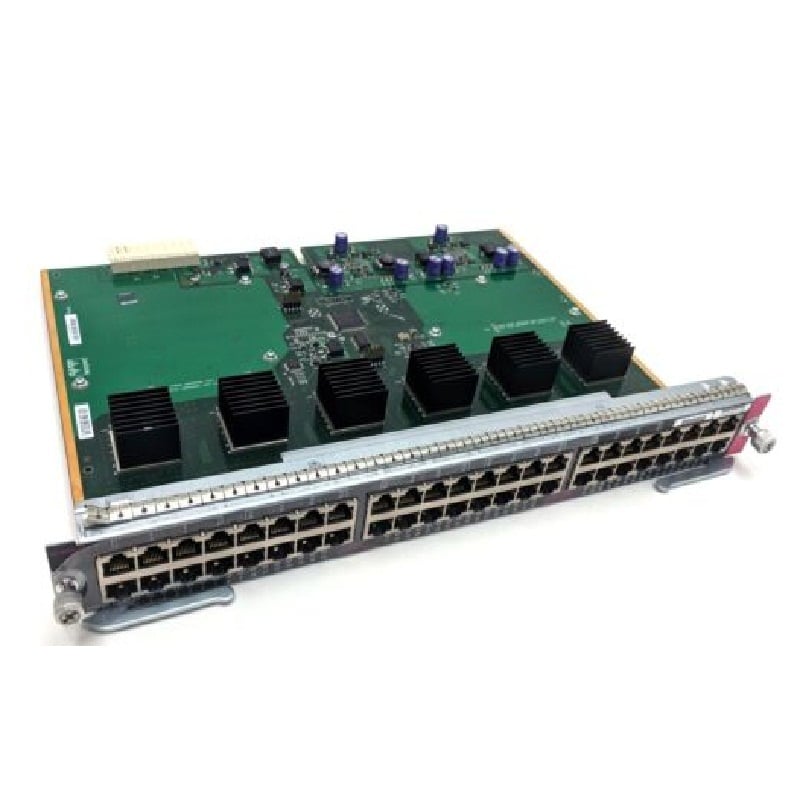
The HPE R8N85-61001 is a managed, rack-mountable switch designed for use in enterprise and data center environments. This switch is part of the HPE Aruba 6000 series and it provides a high-performance, secure, and reliable network infrastructure for connecting a wide range of devices, such as servers, storage, and other network equipment.
The switch is equipped with 48 Gigabit Ethernet ports and 4 Small Form-Factor Pluggable (SFP) ports that can be used for fiber-optic connections. The Gigabit Ethernet ports provide high-speed connectivity for devices, while the SFP ports allow for flexible and scalable fiber-optic connections.
The R8N85-61001 also comes with a wide range of management and security features, such as support for Virtual LANs (VLANs), Access Control Lists (ACLs), and Quality of Service (QoS). These features allow network administrators to segment and secure the network, and prioritize critical traffic.
The switch also supports high availability and redundancy features, such as Port Trunking and Link Aggregation, which increase the resiliency and availability of the network.
The switch is also equipped with web-based management and graphical user interface, which allows for easy configuration and monitoring of the switch, and it supports SNMP, Telnet, and SSH for remote management. It also supports IPv4 and IPv6, which allows for communication with a wide range of devices and networks.
Management and Security Features
The HPE R8N85-61001 Switch has a wide range of management and security features that allow network administrators to segment and secure the network, and prioritize critical traffic. Some of the key management and security features of this switch include:
- Virtual LANs (VLANs): The switch supports VLANs, which allow for the creation of multiple logical networks on a single physical infrastructure. This feature enables network administrators to segment the network and improve security and performance.
- Access Control Lists (ACLs): The switch supports ACLs, which allow network administrators to control access to network resources based on predefined rules. This feature can be used to block unauthorized traffic and improve security.
- Quality of Service (QoS): The switch supports QoS, which allows network administrators to prioritize critical traffic and ensure that mission-critical applications have the bandwidth they need to operate effectively.
- Port Security: The switch supports port security, which allows network administrators to limit the number of MAC addresses that can be learned on a port, and prevent unauthorized devices from connecting to the network.
- Storm Control: The switch supports storm control, which allows network administrators to protect the network from broadcast, multicast, and unknown unicast storm traffic.
- SSH and SSL: The switch supports SSH and SSL, which provide secure remote management and configuration of the switch.
- DHCP Snooping: The switch supports DHCP snooping, which helps prevent rogue DHCP servers from assigning incorrect IP addresses to devices on the network.
- ARP inspection: The switch supports ARP inspection, which helps prevent ARP spoofing attacks by validating ARP packets on the network.
- Network Access Control (NAC): The switch supports NAC, which allows network administrators to control access to the network based on the security posture of a device.
- IEEE 802.1X: The switch supports IEEE 802.1X, which is an industry-standard protocol for authenticating devices on a network.
Redundancy and High Availability
The HPE R8N85-61001 Switch provides several features that allow network administrators to increase the availability of the network and reduce the impact of network failures. Some of the key redundancy and high availability features of this switch include:
- Link Aggregation Control Protocol (LACP): The switch supports LACP, which allows network administrators to bundle multiple physical ports together to form a single logical link. This feature increases the bandwidth available to the network and improves network availability.
- Rapid Spanning Tree Protocol (RSTP): The switch supports RSTP, which is a faster version of the Spanning Tree Protocol (STP) that allows for faster recovery from network failures.
- Multiple Spanning Tree Protocol (MSTP): The switch supports MSTP, which allows network administrators to create multiple spanning tree instances on the network. This feature improves network availability by allowing for multiple active paths in the network.
- Hot Standby Router Protocol (HSRP): The switch supports HSRP, which allows network administrators to configure a standby router to take over in case the primary router fails.
- Virtual Router Redundancy Protocol (VRRP): The switch supports VRRP, which allows network administrators to configure a virtual router that is shared by multiple physical routers. This feature improves network availability by allowing for automatic failover in case of a router failure.
- Switch Clustering: The switch supports switch clustering, which allows multiple switches to be grouped together and managed as a single entity. This feature improves network availability by allowing for automatic failover in case of switch failure.
- Power over Ethernet (PoE) Redundancy: The switch is equipped with PoE redundancy, which allows for continuous power to the PoE devices in the event of a power supply failure.
- Dual Image support: The switch supports Dual Image support, which allows network administrators to have a backup copy of the switch’s firmware and configuration. This feature improves network availability by allowing for faster recovery in case of a firmware failure or corruption.
Virtual LANs (VLANs) and VLAN Tagging
The HPE R8N85-61001 Switch provides several features that allow network administrators to create and manage virtual LANs (VLANs) on the network. Some of the key VLANs and VLAN tagging features of this switch include:
- VLAN Support: The switch supports VLANs, which allow network administrators to create multiple virtual networks on a single physical network. This feature improves network security by isolating different types of traffic and users on the network.
- VLAN Tagging: The switch supports VLAN tagging, which allows network administrators to tag packets with a VLAN identifier. This feature allows the switch to identify the VLAN to which a packet belongs and forward it accordingly.
- VLAN Trunking: The switch supports VLAN trunking, which allows network administrators to carry multiple VLANs over a single link. This feature allows the switch to carry multiple VLANs over a single link, which increases the bandwidth available to the network.
- VLAN Membership: The switch allows network administrators to configure VLAN membership on a per-port basis. This feature allows network administrators to control which devices and users can access which VLANs on the network.
- VLAN Filtering: The switch supports VLAN filtering, which allows network administrators to filter traffic based on VLAN membership. This feature improves network security by preventing unauthorized access to VLANs on the network.
- VLAN Mapping: The switch supports VLAN mapping, which allows network administrators to map VLANs to different ports or interfaces on the switch. This feature allows network administrators to create VLANs that span multiple switches or devices on the network.
- Private VLANs: The switch supports private VLANs, which allow network administrators to create isolated VLANs within a larger VLAN. This feature improves network security by isolating different types of traffic and users on the network.
- VLAN statistics: The switch allows network administrators to view statistics on VLAN usage, such as number of packets and bytes transmitted and received on each VLAN. This feature allows network administrators to monitor network usage and troubleshoot issues related to VLANs on the network.
General Information about the HPE R8N85-61001
- Manufacture : HPE
- Part Number or SKU# R8N85-61001
- Product Type: Managed Switch
Technical Information
- Enclosure Type: Side To Side Airflow Rack-mountable 1u
- Subtype: Gigabit Ethernet
- Ports: 48 X 10/100/1000 (poe+) + 4 X Gigabit Sfp
- Power Over Ethernet (poe): Poe
- Poe Budget: 370 W
Performance
- Performance: Packet Buffer Size: 12.38 Mb Throughput: 77.3 Mpps , Switching Capacity: 104 Gbps , Latency (1 Gbps): 1.9 Us
- Capacity: Switched Virtual Interfaces (svis): 16 , Arp Entries: 1024 , Ipv4 Routes (unicast): 512 , Ipv6 Routes (unicast): 512 , Igmp Groups: 512 , Mld Groups: 512 , Ipv4 Acl Entries (ingress): 256 , Ipv6 Acl Entries (ingress): 128 , Mac Acl Entries (ingress): 256
- Mac Address Table Size: 8192 Entries
- Jumbo Frame Support: 9198 Bytes
- Routing Protocol: Igmpv2, Igmpv3
- Remote Management Protocol: Snmp 1, Snmp 3, Snmp 2c, Http, Https, Radius
Features
- Flow Control, Bootp Support, Arp Support, Vlan Support, Diffserv Support, Ipv6 Support, Sntp Support, Sflow, Multiple Spanning Tree Protocol (mstp) Support, Trivial File Transfer Protocol (tftp) Support, Access Control List (acl) Support, Mld Snooping, Trusted Platform Module (tpm), Fanless, Lacp Support, Lldp Support, Dhcp Client, Management Information Base (mib), Neighbor Discovery Protocol (ndp), Snmp Support, Internet Control Message Protocol (icmp), Dns Client, Lldp-med, User Datagram Protocol (udp), Rapid Reconfiguration Of Spanning Tree (rstp), Ipv6 Addressing.
- Compliant Standards: Ieee 802.3, Ieee 802.1d, Ieee 802.1q, Ieee 802.3ab, Ieee 802.1p, Ieee 802.3af, Ieee 802.3x, Ieee 802.3ad (lacp), Ieee 802.1w, Ieee 802.1s, Ieee 802.3at, Ieee 802.3az
Processor/Memory
- Flash Memory: 16 Gb
- Ram: 4 Gb Ddr3 Sdram
- Processor: 1 X Arm A9: 1.016 Ghz
Expansion / Connectivity
- Interfaces:
- 48 X 10/100/1000 Base-t Rj-45 Poe Class 4 – 370 W
- 4 X Gigabit Lan Sfp
- 1 X Usb Type A
- 1 X Usb-c Console
Power
- Power: Ac 100-240 V (50/60 Hz)
- Power Device: Internal Power Supply
- Voltage Required: Ac 100-240 V (50/60 Hz)
- Power Consumption Operational: 45 Watt