

Description
Deployment and Scalability
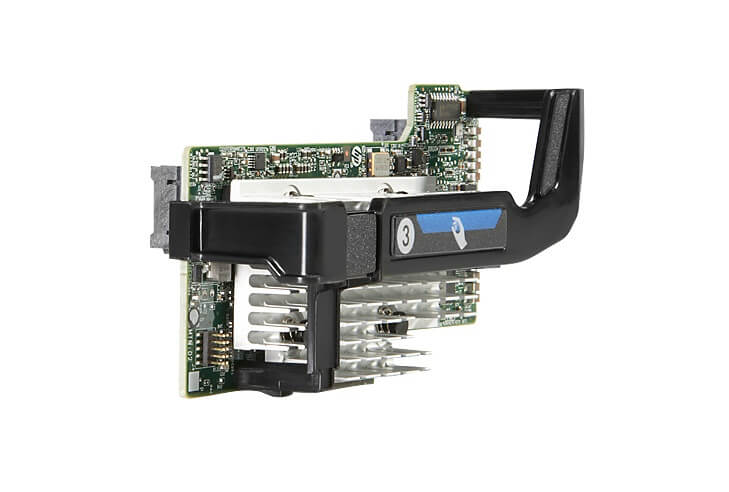
The HPE Flexfabric 20GB 2-Port Adapter is designed to provide organizations with a high degree of deployment flexibility and scalability.
The adapter features a PCI Express v3.0 Gen3 x8 interface, which provides high-speed connectivity to servers and other network devices. This high-speed interface ensures that organizations can take full advantage of the adapter’s 20Gb/s bandwidth capabilities, allowing them to handle high volumes of network traffic and support demanding applications and workloads.
The adapter is also highly scalable, supporting multiple virtual functions (VFs) and virtual machines (VMs) per physical function (PF). This enables organizations to easily deploy and manage multiple virtualized workloads on a single adapter, reducing hardware costs and simplifying network management.
In addition, the HPE Flexfabric 20GB 2-Port Adapter supports a range of operating systems and hypervisors, including Windows, Linux, and VMware ESXi. This ensures that organizations can deploy the adapter in a wide range of environments, and easily integrate it into existing network infrastructure.
Security Features
The HPE Flexfabric 20GB 2-Port Adapter includes a range of security features and protocols designed to help protect sensitive data and ensure the integrity of network communications.
One important security feature is support for Advanced Encryption Standard (AES) 256-bit encryption, which is considered to be highly secure and is widely used in a variety of industries, including healthcare, finance, and government.
In addition to encryption, the adapter also supports a range of authentication protocols, including 802.1x and MACsec, which help to ensure that only authorized users are able to access the network. This can help to prevent unauthorized access to sensitive data and help protect against cyberattacks.
The adapter also supports virtual LAN (VLAN) tagging and link aggregation, which can help to improve network performance and provide additional layers of security by allowing administrators to isolate traffic and segment networks based on user roles or other criteria.
Security Features
Security features are implemented to protect systems, networks, and data from unauthorized access, attacks, and other security risks. Some common security features that are often found in network equipment like adapters and switches include:
- Secure Boot: Secure boot is a security mechanism that ensures that only authorized software is loaded and executed on the system. It prevents malware and other unauthorized software from running during boot-up.
- Access Control: Access control features allow administrators to control who has access to network resources and data. This can include authentication mechanisms like usernames and passwords, and authorization mechanisms that limit access based on user roles and privileges.
- Encryption: Encryption is the process of converting data into a code that can only be read by authorized users with the key to unlock it. Encryption is used to protect data during transmission over the network and when stored on disks or other media.
- Firewall: A firewall is a security device that monitors and controls network traffic based on predefined rules. It can block unauthorized access to the network and prevent malicious traffic from entering or leaving the network.
- Intrusion Detection and Prevention: Intrusion detection and prevention systems (IDPS) are used to monitor network traffic for signs of potential security breaches. They can detect and prevent attacks like port scanning, denial-of-service (DoS) attacks, and other exploits.
- VLANs: Virtual Local Area Networks (VLANs) are used to segment a network into smaller logical networks. This can improve security by limiting access to sensitive resources and data.
- MAC Address Filtering: MAC address filtering is a security mechanism that allows administrators to control which devices can access the network based on their MAC addresses. This can prevent unauthorized devices from connecting to the network.
- Network Access Control: Network Access Control (NAC) is a security technology that enforces security policies on devices that attempt to connect to the network. NAC can be used to verify that devices are running up-to-date antivirus software, have the latest security patches, and meet other security requirements before allowing them to connect to the network.
General Information
- Device Type : Network Adapter
- Form Factor : Plug-In Card
- Interface (Bus) Type : Pci Express 3.0 X8
Networking
- Ports : 20 Gigabit Ethernet X 2
- Connectivity Technology : Wired
- Data Link Protocol : 20 Gigabit Lan
- Data Transfer Rate : 20 GBPS
- Network / Transport Protocol : Tcp/Ip
- Remote Management Protocol : Snmp
Features
- Vlan Support, Wake On Lan (Wol), Full Duplex Mode, Jumbo Frames Support, Pxe Support, Large Send Offload (Lso), Uefi Support, Single Root I/O Virtualization (Sr-Iov), Tcp Segmentation Offload (Tso), Qos Tagging, Extended Message-Signaled Interrupts (Msi-X), Tcp/Ip Checksum Offload, Rdma Over Converged Ethernet (Roce)
Compliant Standards
- IEEE 802.1q, IEEE 802.1p, IEEE 802.3x, IEEE 802.3ad (Lacp), IEEE 802.3ae, IEEE 802.1ab (Lldp), IEEE 802.3ap, IEEE 802.1qbb, IEEE 802.1qaz, IEEE 802.1qbg
Processor / Memory
- Processor : 1 – Emulex
- Expansion / Connectivity:
- Expansion Slots : 1 X Flexiblelom
- Interfaces : 2 X 20gb Ethernet


