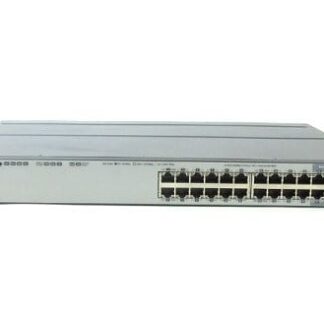


Description
24 Gigabit Ethernet Ports
A 24 Gigabit Ethernet port network switch refers to a device that has 24 ports for connecting Ethernet devices, such as computers, servers, or other switches, to the network. Each port is capable of transmitting data at a rate of 1 Gbps, or gigabit per second, which is a standard speed for Gigabit Ethernet networks.
Gigabit Ethernet is a high-speed networking technology that provides faster data transfer rates compared to the older 10/100 Mbps Ethernet technology. With 24 Gigabit Ethernet ports, a network switch can provide high-speed connectivity for multiple devices, allowing them to communicate with each other quickly and efficiently.
Having 24 Gigabit Ethernet ports on a switch provides a scalable solution for growing networks. This allows administrators to easily expand their network by adding new devices as needed, without the need for multiple switches or upgrading to a larger switch.
Improved Network Security
Improved network security refers to the measures and technologies used to enhance the protection of a network from potential threats, such as cyber attacks, unauthorized access, and data breaches. Improved network security helps ensure the confidentiality, integrity, and availability of sensitive information and resources on the network.
There are several ways to improve network security, including:
- Firewalls: Firewalls act as a barrier between the internal network and the external network, blocking unauthorized access and ensuring that only authorized traffic is allowed to pass.
- Access control: Access control measures, such as user authentication and authorization, ensure that only authorized users are able to access network resources.
- Encryption: Encryption protects sensitive data as it travels across the network, making it unreadable to unauthorized users.
- Virtual Private Networks (VPNs): VPNs allow remote users to securely access the network as if they were physically connected, providing an extra layer of security.
- Intrusion detection and prevention systems (IDPS): IDPS monitor network traffic for suspicious activity and can take action to prevent potential security threats.
- Software and security updates: Regularly updating software and security solutions helps ensure that the network is protected against newly discovered vulnerabilities.
By implementing these and other security measures, organizations can significantly improve the security of their network and better protect sensitive information and resources from potential threats.
Efficient Power Management
Efficient power management refers to the strategies and technologies used to manage the use of electrical power in a network, with the goal of reducing energy consumption and costs while maintaining network performance.
In the context of a network switch, efficient power management can be achieved in several ways, including:
- Power over Ethernet (PoE): PoE enables network switches to deliver both data and power over Ethernet cables, eliminating the need for separate power cables and reducing the overall power consumption of the network.
- Energy Efficient Ethernet (EEE): EEE is a standard that enables network devices to reduce their power consumption during periods of low network utilization, improving energy efficiency and reducing energy costs.
- Power savings mode: Some network switches include a power savings mode that can be enabled during periods of low network utilization, reducing the power consumption of the switch and reducing energy costs.
- Energy-efficient hardware design: Network switches can be designed with energy efficiency in mind, using components and technologies that consume less power and reduce energy consumption.
By implementing these and other power management strategies, organizations can significantly improve the energy efficiency of their network, reduce energy costs, and contribute to a more sustainable future.
General Information about the HPE J9726-61002
- Manufacturer: HPE
- Part Number or SKU# J9726-61002
- Sub-Type: Switch 24 Ports
- Device Type : Switch – 24 Ports – Managed – Stackable
Technical Information
- Enclosure Type : Desktop
- Ports : 24 X 10/100/1000 + 4 X Shared Gigabit SFP
- Performance : Throughput : 95.2 MPPS
- Switching Capacity : 128 GBPS
- Routing Protocol : Rip, Static Ip Routing
- Remote Management Protocol : Snmp 1, Rmon 1, Telnet, Snmp 3, Snmp 2c, Tftp, Cli
- Authentication Method : Radius
- Features : Dos Attack Prevention, Ipv6 Support, Half Duplex Mode, Full Duplex Mode, Class Of Service (Cos)
- Compliant Standards : IEEE 802.3, IEEE 802.3u, IEEE 802.1d, IEEE 802.1q, IEEE 802.3ab, IEEE 802.1p, IEEE 802.3af, IEEE 802.3x, IEEE 802.3ad (Lacp), IEEE 802.1w, IEEE 802.1s, IEEE 802.1v, IEEE 802.3az, IEEE 802.1ax
- Processor : 1 X Arm : 625 MHZ
- Ram : 512 MB – SDRAM
- Flash Memory : 1 GB
Expansion / Connectivity
- Interfaces : 24 X 10base-T/100base-Tx/1000base-T – Rj-45
- 4 X SFP (Mini-GBIC)
- Management : 1 X Rs-232 – Rj-45
- Management : 1 X 5 Pin Micro-USB Type B
- Expansion Slot(S) : 2 (Total) / 2 (Free) X Expansion Slot
- 1 (Total) / 1 (Free) X Stacking Module Slot