

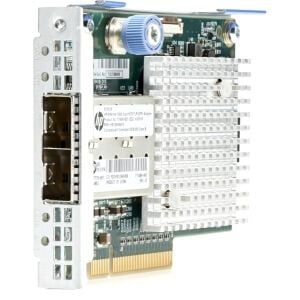
Description
Physical Characteristics of Adapter
The physical characteristics of a network adapter, such as the HPE Ethernet 10GB 2-Port 570flr-SFP+ Adapter, refer to the physical features and specifications of the device. These include its size, shape, weight, and connectors, as well as any other physical attributes that may be relevant to its installation or operation.
Here are some of the physical characteristics of the HPE Ethernet 10GB 2-Port 570flr-SFP+ Adapter:
- Form factor: The adapter is a low-profile PCIe card that is designed to fit into a standard PCIe slot on a server or workstation.
- Dimensions: The adapter measures 6.6 inches in length by 2.7 inches in height, making it a relatively compact device.
- Weight: The adapter weighs approximately 0.2 pounds (90 grams), which is relatively lightweight.
- Ports: The adapter has two SFP+ ports for connecting to fiber-optic network cables.
- LEDs: The adapter has four LEDs on the bracket that indicate link and activity status for each port.
- Cooling: The adapter has a passive heatsink for cooling, which does not require any additional fans or cooling mechanisms.
- Power: The adapter requires a maximum power consumption of 11.6 watts, which is relatively low for a 10GbE adapter.
Network Virtualization Capabilities
Network virtualization capabilities refer to the ability of a network adapter, switch, or other networking device to create multiple virtual networks or partitions within a physical network infrastructure. This allows for more efficient use of network resources, better security, and improved flexibility in managing and scaling network resources.
Network virtualization typically involves creating virtual networks using software-defined networking (SDN) technologies, which can abstract the physical network infrastructure and create logical network segments that are isolated from each other. Each virtual network can have its own set of rules, policies, and configurations, allowing different types of traffic to be prioritized or restricted as needed.
One of the key benefits of network virtualization is that it allows multiple tenants to share the same physical network infrastructure without interfering with each other. This is particularly useful in cloud computing environments, where multiple customers may be sharing the same infrastructure. Network virtualization also simplifies network management by allowing administrators to create, manage, and provision virtual networks using software tools.
In addition to creating virtual networks, network virtualization can also involve the use of virtual network functions (VNFs), which are software-based network services that can be deployed and managed independently of the underlying hardware. VNFs can include services such as firewalls, load balancers, and intrusion detection and prevention systems.
Supported Network Protocols
Supported network protocols refer to the various communication protocols that are supported by a network adapter, such as the HPE Ethernet 10GB 2-Port 570flr-SFP+ Adapter. These protocols determine how data is transmitted and received over the network, and they are essential for ensuring that devices can communicate with each other effectively and efficiently.
Here are some of the network protocols supported by the HPE Ethernet 10GB 2-Port 570flr-SFP+ Adapter:
- Ethernet: The adapter supports standard Ethernet protocols, including 10BASE-T, 100BASE-TX, and 1000BASE-T.
- IEEE 802.3x Flow Control: This protocol allows for the reliable transmission of data over the network by managing the flow of data between devices.
- IEEE 802.1Q VLAN tagging: This protocol allows for the creation of virtual LANs (VLANs) on a physical network, allowing for better segmentation and management of network traffic.
- IEEE 802.3ad Link Aggregation Control Protocol (LACP): This protocol enables the adapter to aggregate multiple physical connections into a single logical connection, providing increased bandwidth and redundancy.
- TCP/IP: The adapter supports the TCP/IP protocol suite, which is the standard set of protocols used for communication on the Internet and most corporate networks.
- iSCSI: The adapter supports the iSCSI protocol, which allows for the transmission of SCSI commands over IP networks, enabling remote storage access over the network.
- Network Time Protocol (NTP): This protocol enables the adapter to synchronize its clock with a network time server, ensuring accurate timekeeping across the network.
Key Features:
- Brand Name: HPE
- Part Number: 717489-001
- Type: Networking
- Sub-Type: Network Adapter 2 Ports
- Device Type : Network Adapter
- Form Factor : Plug-In Card
- Interface (Bus) Type : PCI Express 2.0 X8
- PCI Specification Revision : PCIE 2.0
NETWORKING :
- Ports : 10 Gigabit SFP+ X 2
- Connectivity Technology : Wired
- Data Link Protocol : 10 Gigabit LAN
- Data Transfer Rate 10 : GBPS
- Features : Full Duplex Mode, TCP/IP Offloading, Jumbo Frames Support, PXE Support, Large Send Offload (Lso), Receive Side Scaling (Rss), TCP Segmentation Offload (Tso), Tagged VLAN, Extended Message-Signaled Interrupts (MSI-X), UDP/IP Offloading, Accelerated Receive Flow Steering (RFS)
- Compliant Standards : IEEE 802.3, IEEE 802.1Q, IEEE 802.3X, IEEE 802.3AD (LACP), IEEE 802.3AE, IEEE 802.3P
Expansion / Connectivity
Interfaces : 2 X 10GB Ethernet – SFP+


