

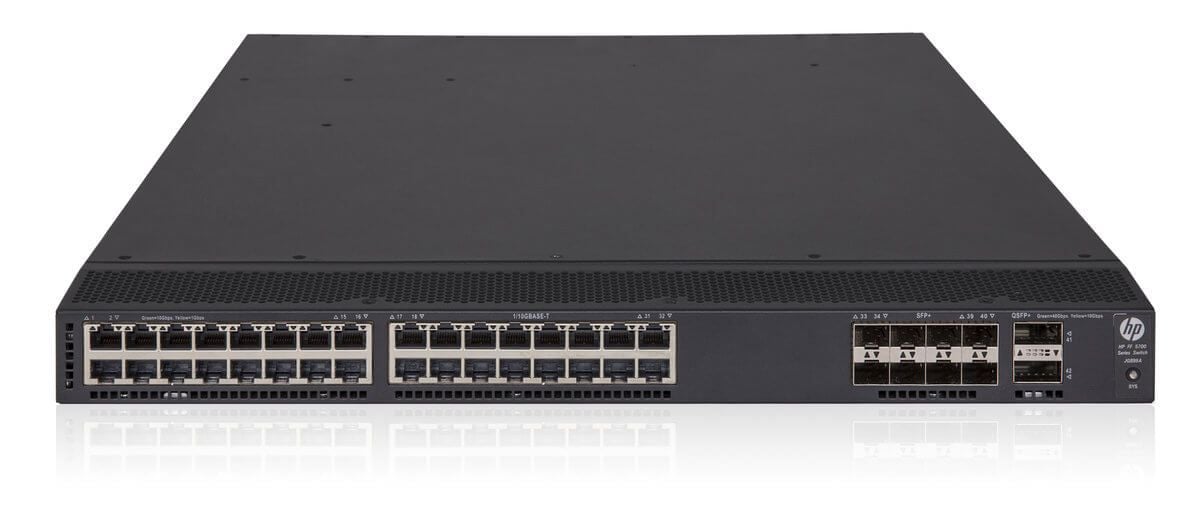
Description
Network Resilience Management
The HPE JG898-61001 Network Resilience refers to the ability of a network to continue functioning properly even in the event of failures or disruptions. Network Resilience Management is the process of implementing and maintaining strategies and technologies that help to improve the resilience and reliability of a network.
In the context of a managed switch like the HPE Flex Fabric 5700-32XGT-8XG-2QSFP+, network resilience can be achieved through various methods, including:
- Link Aggregation: Link Aggregation Control Protocol (LACP) can be used to bundle multiple physical links together, providing redundancy and improving network resilience in the event of a link failure.
- Spanning Tree Protocol (STP) or Rapid Spanning Tree Protocol (RSTP): STP or RSTP can be used to prevent loops in the network and ensure a loop-free topology, improving network resilience in the event of a switch or link failure.
- High Availability: High Availability (HA) technologies such as VRRP (Virtual Router Redundancy Protocol) or GLBP (Gateway Load Balancing Protocol) can be used to provide redundancy and failover capabilities, ensuring that network traffic can continue to flow even in the event of a device failure.
- Redundant Power Supplies: Implementing redundant power supplies can help to ensure that the network remains up and running even in the event of a power failure.
- Network Monitoring and Management: Network monitoring and management tools can be used to detect and respond to network failures and disruptions, helping to minimize downtime and improve network resilience.
By implementing these and other network resilience strategies, administrators can help to ensure that the network remains available and functional even in the event of failures or disruptions, improving the overall reliability and stability of the network.
Multiple Spanning Tree Protocol (MSTP)
Multiple Spanning Tree Protocol (MSTP) is a network protocol used in Ethernet networks to prevent loops and ensure a loop-free topology. MSTP is an evolution of the Spanning Tree Protocol (STP), which provides a way for switches to prevent loops in the network by disabling redundant links. However, STP can only support a single spanning tree, which can limit the scalability and flexibility of the network.
MSTP resolves this issue by allowing multiple instances of the spanning tree algorithm to run concurrently, each representing a separate tree. This allows the network to be divided into multiple virtual LANs (VLANs), and each VLAN can have its own separate spanning tree, thereby improving network scalability.
MSTP operates by sending BPDUs (Bridge Protocol Data Units) between switches, which contain information about the network topology, and are used to determine the best path for data to flow. By using MSTP, switches can detect and eliminate loops in the network, ensuring a stable and reliable network infrastructure.
Security and Access Control
Security and Access Control refer to the set of measures and technologies implemented to secure and regulate access to a network or system. In the context of a managed switch like the HPE Flex Fabric 5700-32XGT-8XG-2QSFP+, security and access control can be achieved through various methods, including:
- Authentication: This ensures that only authorized users can access the network. The switch may support authentication protocols such as RADIUS, TACACS+, or local authentication.
- Access control lists (ACLs): These allow administrators to control access to the network by defining which devices and users are allowed or denied access to specific resources.
- Virtual LANs (VLANs): VLANs can be used to segment the network into different subnets, which can improve security by limiting the spread of network attacks and preventing unauthorized access to sensitive resources.
- Port security: This feature allows administrators to restrict the number of MAC addresses that can be learned on a port, helping to prevent unauthorized devices from accessing the network.
- Network Address Translation (NAT): NAT can be used to hide the internal network IP addresses, making it more difficult for attackers to target specific devices.
- Encryption: Encryption technologies like IPsec can be used to encrypt data in transit, helping to prevent eavesdropping and unauthorized access to sensitive information.
Implementing security and access control measures helps to ensure that the network is protected from unauthorized access and attacks, thereby improving the overall security and stability of the network.
Main Information about the HPE JG898-61001
- Manufacturer: HPE
- Part Number or SKU# JG898-61001
- Product Type: Managed Switch
- Total Number of Ports: 32
Technical Information
- Switch -Type: Switch 32 Ports 10 Gigabit Ethernet
- Device Type : Switch – 40 Ports – L3 – Managed
- Enclosure Type : Rack-Mountable 1U
- Ports : 32 X 10gbase-T + 8 X 10 Gigabit Ethernet Sfp+ / 1 Gigabit Ethernet Sfp+ + 2 X 40 Gigabit Qsfp+ (Uplink)
- Performance : Throughput: 714.2 Mpps ¦ Routing/Switching Capacity: 960 Gbps
- Capacity : Ipv4 Routing Table Entries: 128 ¦ Ipv6 Routing Table Entries: 128 ¦ Virtual Interfaces (Vlans): 4096
- Mac Address Table Size : 128k Entries
- Jumbo Frame Support : Yes
- Routing Protocol : RIP-1, RIP-2, IGMPV2, IGMP, IGMPV3, STATIC IPV4 Routing, Static IPV6 Routing
Expansion / Connectivity
- 32 X 10gbase-T – Rj-45
- 8 X Gigabit / 10gbit Lan – Sfp+
- 2 X 40gbit Lan – Qsfp+ – Uplink
- 1 X Serial (Console) – Rj-45 – Management
- 1 X Usb 2.0 – Management
- 1 X – Rj-45 – Management
Power
- Power Device : Internal Power Supply
- Installed Qty : 0 (Installed) / 2 (Max)
- Power Redundancy : Optional
- Power Redundancy Scheme : 1+1 (With Optional Power Supply)
- Power Consumption Operational : 350 Watt


