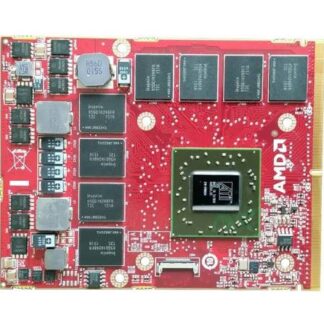


Description
Cooling and Power Consumption
The HPE Nvidia NVS315 video graphics card, part number 720837-001, utilizes a passive cooling system, meaning it doesn’t have a fan and relies on heatsink to dissipate heat. Passive cooling is a good solution for systems that operate in low-noise environments, as it eliminates noise from the fan. However, passive cooling may not be as efficient as active cooling, especially in high temperature environments, or when running the card at high loads for prolonged periods.
In terms of power consumption, the HPE Nvidia NVS315 video graphics card has a low thermal design power (TDP) rating of 30 watts. This means that the card consumes less power than most high-performance graphics cards, making it a good option for systems that have limited power budgets. The card requires a minimum of a 300W power supply unit (PSU), and it requires a standard PCIe x16 slot.
It is important to note that the power consumption and cooling requirements may vary depending on the specific configuration of your system and the workloads you are running. Therefore, it is always recommended to consult the system’s manual and check the power consumption of the entire system to ensure that it meets the power requirements of the card.
Additionally, it’s also important to make sure that the card is properly installed in the system, with good airflow and enough space around the card to dissipate heat.
Performance of Video Graphics Cards
The performance of the HPE Nvidia NVS315 video graphics card, part number 720837-001, will depend on the specific workloads and applications that you are running. However, it is important to note that this card is not designed for gaming or high-performance graphics applications. Instead, it is optimized for professional and enterprise graphics applications, such as video walls, digital signage, and multi-monitor setups.
The HPE Nvidia NVS315 features the Nvidia NVS 315 GPU, which is based on the Fermi architecture. It has 96 CUDA cores and 1GB of GDDR5 memory. The GPU has a base clock speed of 625 MHz and a memory clock speed of 800 MHz. These clock speeds are lower than those of high-performance gaming graphics cards, but they are sufficient for most professional and enterprise graphics applications.
The card supports DirectX 11.0, OpenGL 4.4, OpenCL 1.2, and Shader Model 5.0, which provides a wide range of options for software developers to create visually rich and interactive applications.
The NVS315 also provides support for multi-display environments, up to 4 displays with a resolution up to 2560×1600.
In terms of benchmark results, the HPE Nvidia NVS315 will not score as high as high-performance gaming graphics cards, but it should be able to handle most professional and enterprise graphics applications with ease. You can check benchmarking websites to compare it with other similar video graphics cards, and see how it performs on specific tasks.
It’s important to note that the card’s performance will be influenced by the specific configuration of your system, including the CPU, memory, and other hardware components. Therefore, it’s always recommended to consult the system’s manual, and to run benchmarks on your specific configuration to determine the performance of the card.
Compatibility and System Requirements
Compatibility and system requirements are important factors to consider when using the HPE Nvidia NVS315 video graphics card, part number 720837-001.
Compatibility refers to the ability of the card to work with other hardware components in your system, such as the motherboard and power supply. The HPE Nvidia NVS315 is designed to work with a wide range of professional and enterprise systems, including HPE ProLiant servers and workstations. It is also compatible with other systems that have a PCIe x16 slot and meet the minimum power and cooling requirements.
System requirements refer to the specific hardware and software specifications that must be met in order for the card to function properly. These include a PCIe x16 slot, a 300W power supply unit (PSU) or greater, a minimum of 4GB of system memory, a compatible operating system, and a compatible display or displays with a resolution up to 2560×1600.
It’s important to note that these are the minimum requirements, and that the specific performance and capabilities of the card will depend on the configuration of your system, as well as the specific workloads and applications that you are running. Therefore, it’s always recommended to consult the system’s manual and the vendor’s website for the latest information on compatibility and system requirements. Additionally, it’s also important to make sure that the card is properly installed in the system, with good airflow and enough space around the card to dissipate heat. And also, it’s important to keep your system’s drivers and BIOS updated to ensure that they are compatible with the card and that you are getting the best performance and stability.
General Information
- Manufacturer : HPE
- MPN : 720837-001
- Type : Video Graphics Card
- Video Graphics Card Type : PCI-Express 3.0
Performance
- Product Type : Desktop Graphics Card
- Chipset Manufacturer : NVIDIA
- GPU Clock Speed : 400 MHz
- Memory Size : 1 GB
- Type of Memory : DDR3
- Data-Width of Memory : 64-bit
- Memory Clock Speed : 1.4 GHz
- Max Resolution : 2048×1536