
Description
Memory Capacity and Compatibility
Memory capacity refers to the amount of memory that a computer or device can hold. The more memory a device has, the more programs and data it can store and process at the same time, which can lead to improved performance.
Compatibility refers to the ability of a memory module to work with a specific computer or device. Not all memory modules are compatible with all computers or devices, so it is important to ensure that the memory module you choose is compatible with your specific system.
When it comes to memory capacity and compatibility, there are a few things to keep in mind:
- Maximum capacity: Each computer or device has a maximum amount of memory that it can support. Make sure to check your system’s specifications to determine the maximum amount of memory that it can hold.
- Speed and timings: Memory modules come in different speeds and timings. Make sure to check the speed and timings of the memory module you choose to ensure that it is compatible with your system.
- Form factor: Memory modules come in different form factors, such as DIMM, SO-DIMM, and UDIMM. Make sure to choose a memory module with the correct form factor for your system.
- Error-correcting code (ECC): Some systems require ECC memory, while others do not. Make sure to check your system’s specifications to determine if ECC memory is required.
- Brand and Model: It’s recommended to use the memory that is recommended by the manufacturer of the server or workstation.
By ensuring that the memory module you choose is compatible with your system in terms of capacity, speed, timings, form factor, ECC and brand, you can ensure that you are getting the best performance and reliability from your system.
Data Integrity and Error Correction
Data integrity refers to the accuracy and completeness of the data stored in a computer’s memory. Error correction, also known as Error-Correcting Code (ECC) is a technique used to detect and correct errors that may occur in the data stored in memory.
ECC memory uses additional hardware to detect and correct errors in the data stored in memory, which helps to maintain the integrity of the data. The ECC memory uses a technique called parity, which adds an extra bit to each byte of data stored in memory. This extra bit, called the parity bit, is used to detect errors in the data. When an error is detected, the ECC memory can use the parity bit to correct the error and maintain the integrity of the data.
Data integrity is important in many applications, especially in servers, workstations and other high-performance systems where data integrity and reliability are critical. In these systems, data corruption can lead to system crashes, data loss and even financial loss.
ECC memory is particularly useful in these systems, as it can detect and correct errors before they cause serious problems. This can help to improve the reliability and availability of the system, and can also help to prevent data loss and corruption.
How the Dual Rank DDR4 Technology Enhances Performance
Dual rank DDR4 technology is a feature that enhances the performance of computer memory by allowing for more data to be accessed simultaneously.
Each rank of memory is a 64-bit wide memory channel, so with dual rank memory, the memory controller can access two 64-bit memory channels at the same time, effectively doubling the memory bandwidth. This allows for more data to be processed at once, resulting in faster performance.
Additionally, dual rank DDR4 technology allows for more memory capacity to be installed on a system, as it allows for 2 DIMMs to be populated on a channel instead of just one.
It also allows for better utilization of the memory controller and memory bus, which can lead to an increase in overall system performance.
Comparison to Non-ECC RAM
The speed and latency of memory refers to how fast the memory can transfer data and how long it takes for the memory to respond to a request for data.
The HPE 32GB ECC RAM typically operates at a speed of 2666 MHz or 2933 MHz. The speed of memory is measured in MHz or GHz, and a higher number indicates that the memory can transfer data faster. Operating at a speed of 2666 MHz or 2933 MHz, the HPE 32GB ECC RAM is considered to be fast memory, suitable for high-performance systems.
Latency, also known as CAS latency, refers to the delay between the time a memory controller requests data and the time the data is available. Latency is measured in clock cycles and a lower number indicates lower latency and faster memory. The HPE 32GB ECC RAM typically has a CAS latency of 19 or 21, which is considered to be low latency, suitable for high-performance systems.
It’s important to note that the specific speed and latency of the HPE 32GB ECC RAM may vary depending on the specific model and configuration. It’s always a good idea to check the manufacturer’s specifications or consult with the manufacturer to ensure that the memory is compatible and will perform as expected in the system.
General Information
- Manufacturer: HPE
- Manufacturer Part Number: 803668-S21
- Type: Memory (RAM)
- Sub-Type: PC4-17000
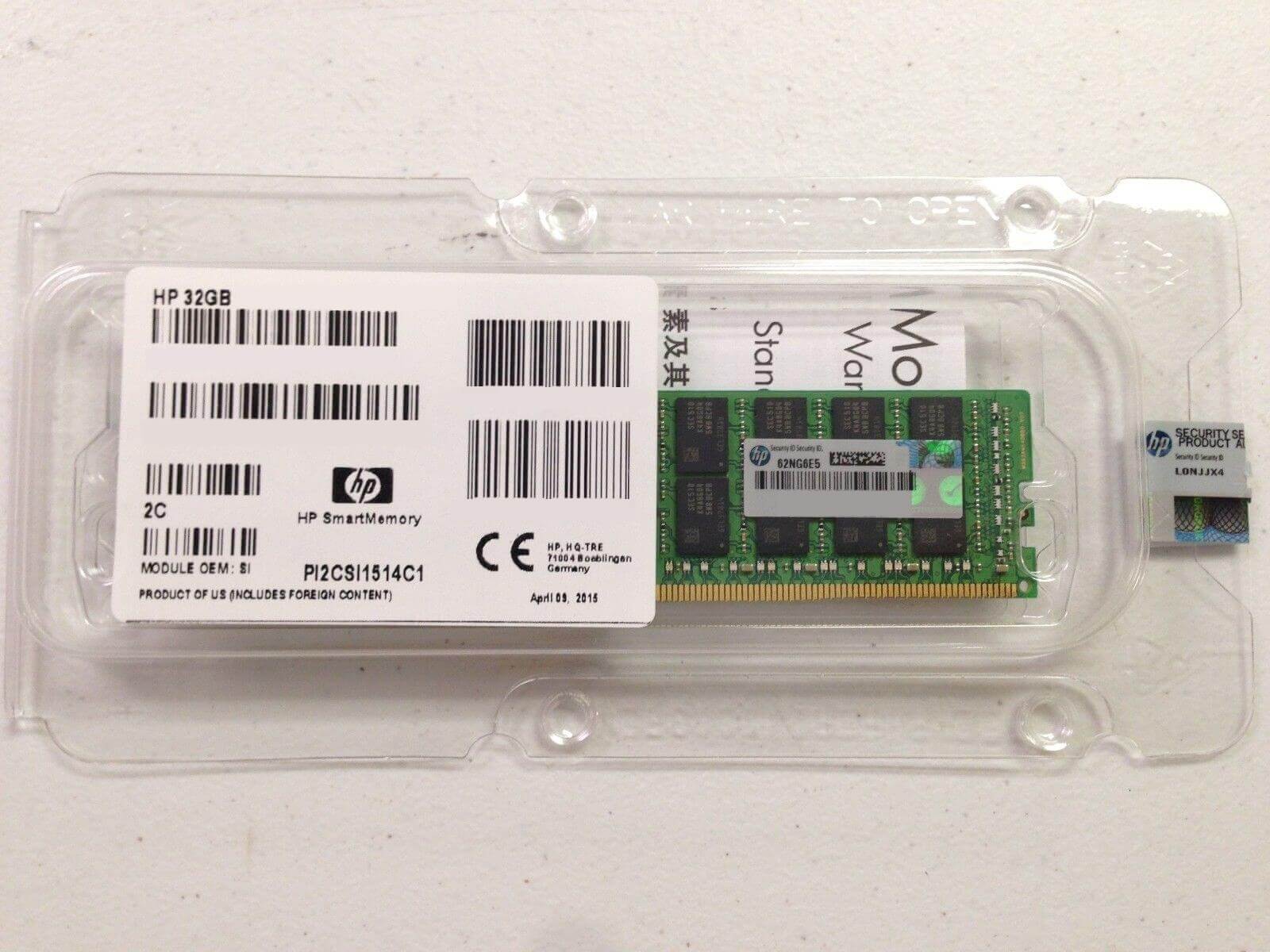
- Product Name: 32GB DDR4 SDRAM Memory Module
Technical Information
- Storage Capacity: 32GB
- Memory Technology: DDR4 SDRAM
- Number Of Modules: 1 X 32GB
- Bus Speed: 2133mhz DDR4-2133/PC4-17000
- Data Integrity Check: Ecc
- Signal Processing: Registered , Dual Rank
- Cas Latency Timings: Cl15
- Component Rank: 4rx4
- Cas Latency: Cl15
- Pin Count: 288-Pin
- Voltage: 1.20v
Compatibility
- HPE Apollo 4200 Gen9, 4510 Gen9, 4520 Gen9, 4530, Proliant Bl460c Gen9, Bl660c Gen9, Dl160 Gen9, Dl180 Gen9, Dl360 Gen9, Dl380 Gen9, Dl388 Gen9, Dl560 Gen9, Dl580, Dl580 Gen9, Dl80 Gen9, Ml350 Gen9, Ws460c Gen9, Xl170r Gen9, Xl190r Gen9, Xl230a Gen9, Xl250a Gen9