


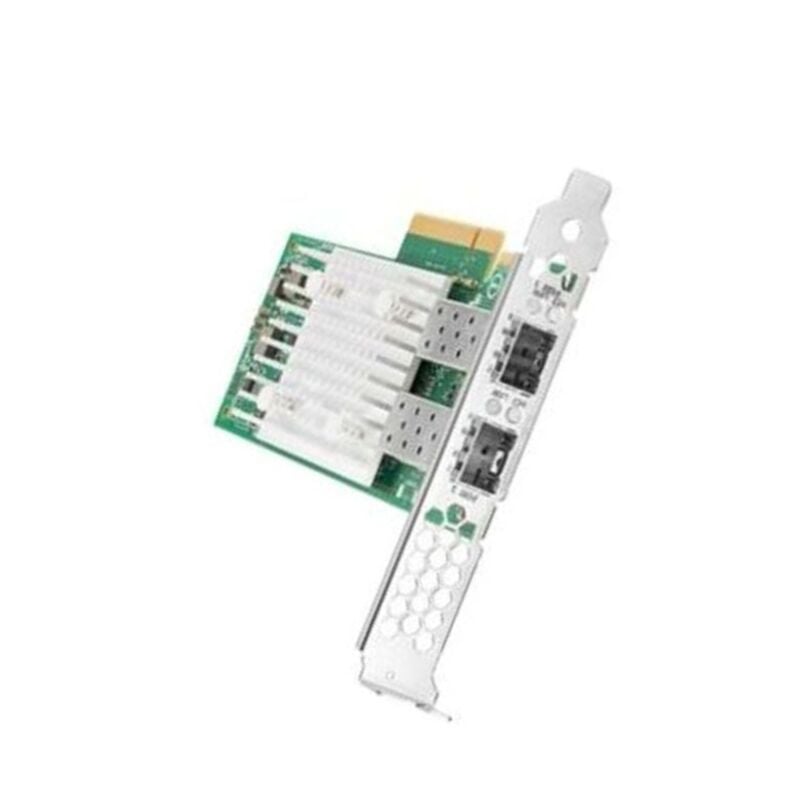
Description
Network Interface Controller (NIC)
A Network Interface Controller (NIC), also known as a network interface card or Ethernet card, is a hardware component that allows a computer to connect to a network. It serves as the interface between the computer’s operating system and the network, providing a physical connection and communication protocol between the two.
A NIC typically consists of a printed circuit board with an Ethernet port for attaching a network cable, as well as a controller chip that manages the data transfer between the computer and the network. Some NICs may also include additional functionality, such as support for wireless networking or other protocols.
When a computer sends data over a network, it is typically first transmitted to the NIC, which packages the data into frames and transmits them over the network cable or wireless connection. Similarly, when data is received from the network, the NIC processes the incoming frames and passes the data up to the operating system for further processing.
NICs can come in a variety of different speeds and connection types, ranging from legacy 10/100 Mbps Ethernet to modern 10 Gigabit Ethernet (10 GbE) and beyond. NICs may also support various advanced features, such as quality of service (QoS) and virtual LAN (VLAN) tagging, which allow for more granular control over network traffic and segmentation.
Configuration Options
Configuration options refer to the settings and parameters that can be customized to control the behavior and functionality of a hardware component or software application. For the HPE 867705-001 Ethernet 10GB 2-Ports 521t Adapter, there may be several configuration options available to fine-tune its operation and optimize its performance in a specific network environment.
Some examples of configuration options for the HPE 867705-001 adapter might include:
- Network settings: This could include options such as IP address, subnet mask, and default gateway settings. These settings would typically be configured to match the network topology and addressing scheme being used in the local network.
- Link aggregation control protocol (LACP) settings: The HPE 867705-001 adapter supports LACP, which allows multiple network links to be aggregated together for improved throughput and redundancy. Configuration options for LACP might include the number of links to use, the load balancing algorithm, and the failover behavior.
- Virtual LAN (VLAN) settings: The adapter also supports VLAN tagging, which allows network traffic to be segmented into different virtual LANs for improved security and traffic management. Configuration options for VLANs might include the VLAN ID and priority settings.
- Quality of service (QoS) settings: The HPE 867705-001 adapter also supports QoS, which allows certain types of network traffic to be prioritized over others. Configuration options for QoS might include the type of traffic to prioritize, the priority level, and the maximum bandwidth allocation.
- Jumbo frame settings: The adapter supports jumbo frames, which allow larger data packets to be transmitted over the network for improved performance. Configuration options for jumbo frames might include the maximum frame size to use and whether or not to enable jumbo frames at all.
Segmentation Capabilities
Segmentation capabilities refer to a network adapter’s ability to segment network traffic into separate virtual networks or subnets based on different criteria, such as application type, user group, or security requirements. This helps to improve network performance, security, and scalability by isolating different types of traffic and allowing for more granular control over network traffic flow.
The HPE 867705-001 Ethernet 10GB 2-Ports 521t Adapter supports segmentation capabilities through several key features, including:
- Virtual LAN (VLAN) tagging: The adapter supports VLAN tagging, which allows network traffic to be segmented into different virtual LANs for improved security and traffic management. VLAN tagging can also help to reduce network congestion by separating different types of traffic onto separate network segments.
- Quality of service (QoS): The adapter also supports QoS, which allows certain types of network traffic to be prioritized over others. This can be useful for prioritizing critical applications or ensuring that real-time traffic, such as voice or video, receives the necessary bandwidth and latency requirements.
- Jumbo frame support: The adapter supports jumbo frames, which can improve network performance by reducing the number of packets that need to be transmitted for a given amount of data. This can be particularly useful for large data transfers, such as those involving large files or database transactions.
- Network virtualization: The adapter supports network virtualization technologies such as VXLAN and NVGRE, which allow for the creation of virtual overlay networks that can be segmented based on different criteria. This can help to improve network scalability and flexibility, as well as provide additional security and isolation for different types of traffic.
General Information about this HPE 867705-001
- Manufacturer: HPE
- Part Number or SKU# 867705-001
- Type: Networking
- Device Type: Ethernet Adapter
Technical Information of 2-Ports Adapter
- Number of Ports: 2 Ports
- Form Factor: Plug-in Card
- Interface (bus) Type: Pci Express 3.0 X8
- Ports: 10GB Ethernet X 2
- Data Link Protocol: 10 Gige
- Data Transfer Rate: 10 Gbps
- Processor: Ql41401 – Cavium
- Features : Vlan Support, Wake On Lan (wol), Ipv6 Support, Jumbo Frames Support, Pxe Support, Single Root I/o Virtualization (sr-iov), Precision Time Protocol (ptp), Rdma Over Converged Ethernet (roce), Virtual Extensible Lan (vxlan), Rdma Over Converged Ethernet (roce) V2, Receive Side Coalescing (rsc), Hpe Sea Of Sensors 3d, Mware Netqueue And Microsoft Virtual Machine Queue (vmq), Iscsi Extensions Over Rdma (iser)
Compliant Standards for Ethernet Adapter
- Ieee 802.1q, Ieee 802.1p, Ieee 802.1as, Ieee 802.3az, Ieee 802.1qbb, Ieee 802.1qaz, Ieee 802.3by


