

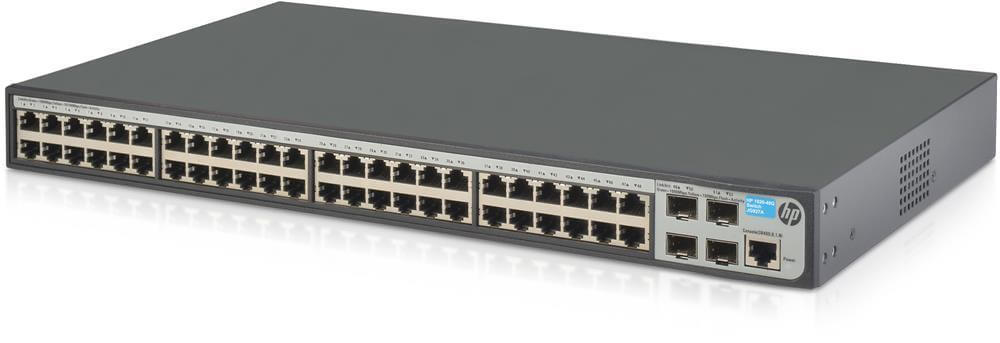
Description
Benefits and Advantages of the HPE JC691-61001
The JC691-61001 HPE 5830AF 48G Switch offers a variety of benefits and advantages that make it a great choice for businesses looking to upgrade their network infrastructure.
One of the main benefits of the switch is its high-speed connectivity. The switch is equipped with 48 Gigabit Ethernet ports, providing high-speed connectivity for a large number of devices on the network. This high-speed connectivity enables the switch to handle large amounts of network traffic and support high-bandwidth applications, such as video streaming and virtualization.
Another benefit of the switch is its scalability. The switch has 1 interface slot that allows for additional interfaces to be added, providing more connectivity options and allowing the switch to grow with the needs of the network.
The switch also offers a high level of manageability and control. The switch supports advanced management features, including SNMP and RMON, which allows for remote monitoring and management of the switch. This makes it easy to detect and troubleshoot issues with the switch, minimizing downtime.
Additionally, the switch also supports advanced security features, including Access Control Lists (ACLs) and Virtual LANs (VLANs), which can help to prevent network security threats, such as unauthorized access and malware.
Furthermore, the switch is rack mountable, which makes it easy to install in a data center or other equipment room.
Solutions for Enterprise Networking
Enterprise networking solutions are designed to meet the complex and demanding needs of businesses with large, distributed networks. These solutions are typically built to be scalable, reliable, and secure, and are often managed by advanced network management software.
One of the key solutions for enterprise networking is the use of high-performance, multi-layer switches. These switches provide high-speed connectivity for a large number of devices on the network and are capable of handling large amounts of network traffic. They also support advanced features such as Quality of Service (QoS) and Virtual LANs (VLANs) which help to ensure that critical applications receive the necessary bandwidth, and that different departments or users are isolated from each other on the network.
Another important solution for enterprise networking is the implementation of routing protocols, such as OSPF and BGP, which enable the efficient and effective routing of traffic between different parts of the network. These protocols help to ensure that data is delivered quickly and reliably across the network, even when there are multiple paths available.
Additionally, enterprise networking solutions often include the use of firewalls and other security measures, such as intrusion detection and prevention systems, to protect the network from unauthorized access and malware. These security solutions are essential for maintaining the integrity and confidentiality of sensitive data, and for complying with industry regulations.
Another important aspect of enterprise networking is the management and monitoring of the network. Network management software provides administrators with a central view of the network, and allows them to monitor the performance of devices, troubleshoot issues, and configure devices remotely.
Large-Scale Switch Deployments
Large-scale switch deployments refer to the implementation of a large number of switches in a network to support a large number of devices and users. These deployments can be found in enterprise networks, data centers, or other large-scale environments.
One of the main challenges in large-scale switch deployments is the management and configuration of the switches. With a large number of switches in the network, it can be difficult to ensure that all switches are configured consistently and that the network is running optimally.
To overcome these challenges, many organizations use network management software to manage and monitor their large-scale switch deployments. This software allows administrators to configure and monitor multiple switches from a single location, and provides a central view of the network. It also allows for automated configuration and deployment of new switches, which can help to ensure consistency across the network.
Another important aspect of large-scale switch deployments is the use of network protocols such as Link Aggregation Control Protocol (LACP) and Virtual Link Trunking (VLT) to increase the available bandwidth and improve the reliability of the network. These protocols allow multiple physical links to be bundled together to create a single logical link, which can help to ensure that the network is always available, even if one of the physical links fails.
Additionally, large-scale switch deployments often include the use of advanced features such as Quality of Service (QoS) and Virtual LANs (VLANs) to help ensure that critical applications receive the necessary bandwidth and that different departments or users are isolated from each other on the network.
General Information
- Manufacturer: HPE
- Model Number or SKU# JC691-61001
- Type: Networking
- Sub-Type: Switch 48 Ports
Technical Information
- Device Type : Switch – 48 Ports – L3 – Managed
- Enclosure Type : Rack-Mountable – 1u
- Ports : 48 X 10/100/1000 + 2 X Shared Sfp + 2 X 10 Gigabit Ethernet / 1 Gigabit Ethernet Sfp+
Performance
- Switching Capacity : 160 Gbps Throughput : 119 Mpps
- Capacity : Routing Table Entries : 12000
- Mac Address Table Size : 32000 Entries
Routing Protocol
- Ospf, Rip, Bgp-4, Rip-2, Bgp, Igmpv2, Igmp, Ospfv2, Pim-Sm, Pim-Dm, Igmpv3, Ospfv3, Pim-Ssm, Msdp, Static Ipv4 Routing, Static Ipv6 Routing, Mldv2, Mld
- Remote Management Protocol : Snmp 1, Rmon, Telnet, Snmp 3, Snmp 2c, Http, Tftp, Cli
- Encryption Algorithm : Md5, Ike, Ssl, Tls
- Authentication Method : Secure Shell (Ssh), Radius, Pap, Chap, Tacacs, Tacacs+, Secure Shell V.2 (Ssh2)
Features
- Flow Control, Dhcp Support, Vlan Support, Igmp Snooping, Port Mirroring, Mac Address Filtering, Ipv6 Support, Half Duplex Mode, Full Duplex Mode, Sflow, Rapid Spanning Tree Protocol (Rstp) Support, Virtual Route Redundancy Protocol (Vrrp) Support, Multiple Spanning Tree Protocol (Mstp) Support, Access Control List (Acl) Support, Quality Of Service (Qos), Committed Access Rate (Car), Mld Snooping, Per-Vlan Spanning Tree Plus (Pvst+), Device Link Detection Protocol (Dldp) Support, Rapid Ring Protection Protocol (Rrpp) Support, Equal-Cost Multipath (Ecmp), Endpoint Admission Defense (Ead), Lldp Support
Compliant Standards
- Ieee 802.3, Ieee 802.3u, Ieee 802.3z, Ieee 802.1q, Ieee 802.3ab, Ieee 802.1p, Ieee 802.3x, Ieee 802.3ad (Lacp), Ieee 802.1w, Ieee 802.1x, Ieee 802.3ae, Ieee 802.3ac, Ieee 802.1s, Ieee 802.1ad, Ieee 802.3ah, Ieee 802.1ag, Ieee 802.1ab (Lldp), Ieee 802.3at
- Ram : 1 Gb
- Flash Memory : 64 Mb
Expansion / Connectivity
- Interfaces : 48 X 10base-T/100base-Tx/1000base-T – Rj-45 2 X Sfp (Mini-Gbic) 2 X Sfp+ Serial : 1 X Console – Rj-45 1 X Rj-45 – Management Expansion Slot(S) : 1 (Total) / 1 (Free) X Expansion Slot


