

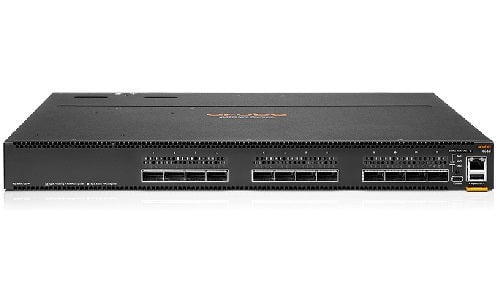
Description
Virtual Local Area Network (VLAN)
A Virtual Local Area Network (VLAN) is a logical grouping of network devices, such as computers and switches, that behave as if they were connected to a single broadcast domain, even though they may be physically connected to different switches in a larger network. VLANs are used to segment a network into smaller, isolated network segments, improving security, performance, and manageability.
In the context of the HPE Aruba 8360 Switch, the switch supports VLANs and allows network administrators to create and configure multiple VLANs on the same physical network. Each VLAN is assigned a unique identifier, called a VLAN ID, and devices on the same VLAN can communicate with each other as if they were connected to the same physical switch.
VLANs can be used to segment a network into smaller, isolated network segments based on specific criteria, such as department, function, or security requirements. For example, a network administrator might create separate VLANs for each department in an organization, or for different security zones in a network.
Power and Energy Efficiency
The “Power and Energy Efficiency” subheading refers to the power consumption and energy efficiency of the HPE Aruba 8360 Switch.
One of the main concerns in managing modern networks is reducing energy consumption and optimizing the use of resources. The HPE Aruba 8360 Switch is designed with energy efficiency in mind, and includes features to minimize power consumption and reduce energy costs.
Some of the energy efficiency features available on the HPE Aruba 8360 Switch include:
- Power over Ethernet (PoE): The switch supports Power over Ethernet (PoE), which allows power to be delivered to connected devices over the Ethernet cable. This eliminates the need for separate power supplies and reduces energy costs.
- Energy Efficient Ethernet (EEE): The switch supports Energy Efficient Ethernet (EEE), a standard that reduces power consumption in Ethernet devices by putting the device into a low-power mode when not in use.
- Power Consumption Monitoring: The switch provides tools for monitoring power consumption and identifying devices that are using excessive amounts of power.
- Energy Star Certification: The switch is Energy Star certified, meaning that it meets strict energy efficiency guidelines set by the US Environmental Protection Agency (EPA).
Management and Configuration
The “Management and Configuration” subheading refers to the ways in which the HPE Aruba 8360 Switch can be managed and configured. This includes both the software tools and interfaces used to monitor and control the switch, as well as the various configuration options available to customize the switch to meet specific network requirements.
The HPE Aruba 8360 Switch can be managed through a web-based interface, a command-line interface (CLI), or using management protocols such as SNMP or REST API. These management tools allow network administrators to monitor the status of the switch, configure its various settings, and upgrade its software.
In terms of configuration options, the HPE Aruba 8360 Switch supports a range of features, such as VLANs, Quality of Service (QoS), Link Aggregation Control Protocol (LACP), Spanning Tree Protocol (STP), and others. These features can be configured through the switch’s management interface to meet specific network requirements, such as increased security, improved network performance, or increased reliability.
General Information about the HPE JL709A
- Manufacturer: HPE
- Part Number or SKU# JL709A
- Type: Networking
- Switch Type: 12 Ports Switch
Technical Information
- Switching Capacity: 2.4 TBPS ¦ Latency: 1 ?s ¦ Throughput: 2 MBPS
- Capacity : Virtual Interfaces (Vlans) Per Port For 802.1q: 4094
- Jumbo Frame Support : 9kb
- Routing Protocol : Ospf, Egp, Bgp-4, Bgp, Igmpv2, Igmp, Vrrp, Pim-Sm, Static Ip Routing, Igmpv3, Gre, Ospfv3, Static Ipv4 Routing, Static Ipv6 Routing, Ecmp, Policy-Based Routing (Pbr), Mldv2, Mld, Mstp, Rstp, Stp
- Remote Management Protocol : Snmp, Rmon, Snmp 3, Snmp 2c, Tftp, Ssh, Ssh-2, Cli, Sftp, Ntp, Icmp, Ipv4, Ipv6, Rstp
- Encryption Algorithm : Fips 140-2
- Authentication Method : Secure Shell (Ssh), Radius, Tacacs+, Secure Shell V.2 (Ssh2)
- Features : Flow Control, Ip-Routing, Dhcp Support, Arp Support, Vlan Support, Igmp Snooping, Port Mirroring, Manageable, Ipv6 Support, Sflow, Spanning Tree Protocol (Stp) Support, Rapid Spanning Tree Protocol (Rstp) Support, Multiple Spanning Tree Protocol (Mstp) Support, Access Control List (Acl) Support, Quality Of Service (Qos), Jumbo Frames Support, Mld Snooping, Bidirectional Forwarding Detection (Bfd), Uni-Directional Link Detection (Udld), Rapid Per-Vlan Spanning Tree Plus (Pvrst+), Ipv4 Support, Deficit Weighted Round Robin (Dwrr), Link Aggregation Control Protocol (Lacp), Data Center Bridging (Dcb), Fan Tray, Redundant Hot Swappable Fans, Congestion Control, Packet Storm Protection, Strict Priority (Sp), Loopback, Multicast Source Discovery Protocol (Msdp), Ethernet Ring Protection Switching (Erps), Macsec Support, Vxlan Tunnel Endpoints (Vtep) Support, Explicit Congestion Notification (Ecn), Bridge Protocol Data Unit (Bpdu), Internet Control Message Protocol (Icmp), 32mb Packet Buffer, Virtual Extensible Lan (Vxlan), Link Aggregation, Fast Leave, User Datagram Protocol (Udp), Protocol Independent Multicast (Pim), Cisco Ios Ip Service-Level Agreements (Ipsla), Rapid Reconfiguration Of Spanning Tree (Rstp), Broadcast Mode, Virtual Switch Extension (Vsx), Multicast Routing
- Compliant Standards : IEEE 802.3z, IEEE 802.1d, IEEE 802.1q, IEEE 802.1p, IEEE 802.3x, IEEE 802.3ad (Lacp), IEEE 802.1w, IEEE 802.3ae, IEEE 802.1s, IEEE 802.1t, IEEE 802.1ab (Lldp), IEEE 802.1ak, IEEE 802.3ba, IEEE 802.1ax
Processor
- 1: 1.8 GHz
- Ram : 16 GB
- Flash Memory : 32 GB
Expansion / Connectivity
- Interfaces : 12 X 100gbit/40gbit Lan ¦ 1 X Serial (Console) ¦ 1 X Usb-C Console ¦ 1 X Lan Rj-45 ¦ 1 X Usb Type A


